The Elusive Dance: How Butterflies Master Visual Deception to Evade Predators
The Elusive Dance: How Butterflies Master Visual Deception to Evade Predators
Introduction
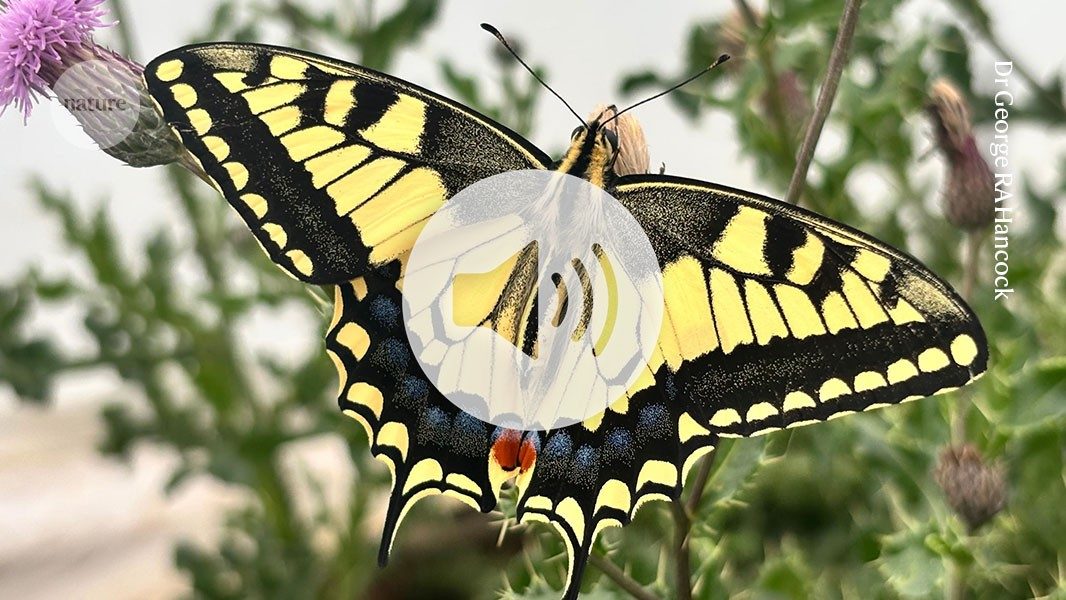
The seemingly effortless flutter of a butterfly, a common sight in gardens and meadows, belies a complex and highly evolved survival strategy. For centuries, observers have marveled at the difficulty of catching these delicate creatures, often attributing it to their erratic flight patterns. However, recent scientific investigations, highlighted in the latest Nature Podcast, delve deeper, revealing that butterflies are masters of visual deception. Their flight dynamics generate sophisticated optical illusions that actively confuse and deter predators, particularly birds, which rely heavily on visual cues for hunting. This phenomenon, detailed in research by Hancock et al., offers a fascinating glimpse into the evolutionary arms race between predator and prey, where visual perception plays a critical role.
Key Details
- Confusing Motion Cues: Butterflies in flight generate complex and rapidly changing visual signals that disrupt a predator's ability to accurately track their trajectory.
- Predator Bafflement: These motion cues are designed to overload or mislead the visual processing systems of predators, such as birds, making capture significantly more challenging.
- Research Focus: The work by Hancock et al. specifically investigates how the physical movements of butterfly wings and bodies create these disorienting visual effects.
- Evolutionary Advantage: The ability to create such visual illusions provides a significant survival advantage, contributing to the long-term success and diversity of butterfly species.
- Broader Implications: Understanding these mechanisms can inform biomimicry, robotics, and our general understanding of visual perception and predator-prey dynamics in the natural world.
Background
The study of predator-prey relationships is a cornerstone of ecological science. For many flying predators, like birds, vision is their primary sense for detecting and capturing prey. This makes visual camouflage and evasive maneuvers critical for survival. While some prey animals rely on blending into their environment (cryptic coloration) or startling predators with sudden movements, butterflies appear to employ a more active form of visual disruption. Their wings, often brightly colored, are not just for display or thermoregulation; they are dynamic surfaces that, in conjunction with their flight path, can create a barrage of conflicting visual information. This can include rapid changes in apparent size, shape, and direction, which can overwhelm the predator's visual system, leading to missed strikes. The research by Hancock et al. builds upon decades of ecological observation and advances in understanding animal vision and neurobiology. Previous studies have explored how certain insects use wing patterns to mimic larger, more dangerous animals or to create disruptive coloration that breaks up their outline. However, this new research focuses specifically on the dynamic, motion-based illusions generated during flight.
Analysis
The findings from Hancock et al. suggest that butterflies are not merely reacting to predators but are actively manipulating their visual environment. The complex aerodynamics of their flight, characterized by rapid wing beats, fluttering, and sudden changes in direction, are not random. Instead, they appear to be finely tuned to exploit the limitations of avian visual processing. Birds, like many vertebrates, have visual systems that process motion and form. However, when presented with highly erratic and rapidly changing stimuli, their ability to predict the prey's future position can be compromised. This is akin to how optical illusions work on humans, where visual cues are manipulated to trick the brain into perceiving something that isn't there or misinterpreting spatial relationships. For butterflies, this means their flight can create a kind of ‘visual noise’ that makes them appear to jump, disappear, or change direction instantaneously from the predator’s perspective. This ‘motion camouflage’ or ‘visual confusion’ strategy is a powerful evolutionary adaptation. It means that even if a bird spots a butterfly, the chances of a successful capture are significantly reduced, allowing the butterfly to escape and reproduce. The research also touches upon the role of wing coloration in conjunction with motion. While the primary mechanism discussed is motion-based illusion, the patterns and colors on butterfly wings might also play a role in amplifying these effects, perhaps by creating strobing patterns or further confusing depth perception as the wings move.
Furthermore, the research highlights the sophistication of natural selection. Over millions of years, butterflies that possessed even slight advantages in generating confusing flight patterns would have been more likely to survive and pass on their genes. This iterative process would have refined their flight mechanics and potentially their wing morphology to maximize their evasive capabilities. The study also implicitly raises questions about the sensory capabilities of predators. The fact that butterflies have evolved such effective strategies suggests that predators, while formidable, have their own limitations. Understanding these limitations is key to understanding the entire predator-prey dynamic. The Nature Podcast also briefly mentions other research highlights, such as Menezes and Podos’ work, which might explore different aspects of animal communication or adaptation, and the intriguing discovery of a large Iron Age metal hoard, underscoring the breadth of scientific inquiry covered by the podcast.
Conclusion
The seemingly simple act of a butterfly evading capture is, in fact, a testament to complex evolutionary adaptations involving sophisticated visual deception. The research by Hancock et al., as featured in the Nature Podcast, illuminates how butterflies leverage their flight dynamics to create optical illusions that confound predators, particularly birds. This ‘elusive dance’ is a powerful example of how natural selection shapes organisms to exploit the perceptual limitations of their adversaries. By generating confusing motion cues, butterflies significantly enhance their chances of survival, ensuring the continuation of their species. This ongoing evolutionary arms race between predator and prey continues to inspire scientific curiosity, offering valuable insights into visual perception, biomechanics, and the intricate web of life. The study serves as a reminder that even the most familiar creatures harbor profound biological secrets, waiting to be uncovered through dedicated scientific exploration.
Source: nature.com