Feathers Found in Dinosaur Feces Offer Clues to Avian Extinction
Introduction
In a remarkable discovery that pushes the boundaries of paleontological understanding, scientists have identified the first-ever fossilized feathers preserved within dinosaur droppings. This groundbreaking find, detailed in the journal Current Biology, offers an unprecedented glimpse into the lives of ancient birds and provides potential clues as to why some avian lineages survived the cataclysmic event that wiped out the dinosaurs, while others perished.
Key Details
- Discovery: The first feathers ever found encased in fossilized dinosaur feces (coprolite).
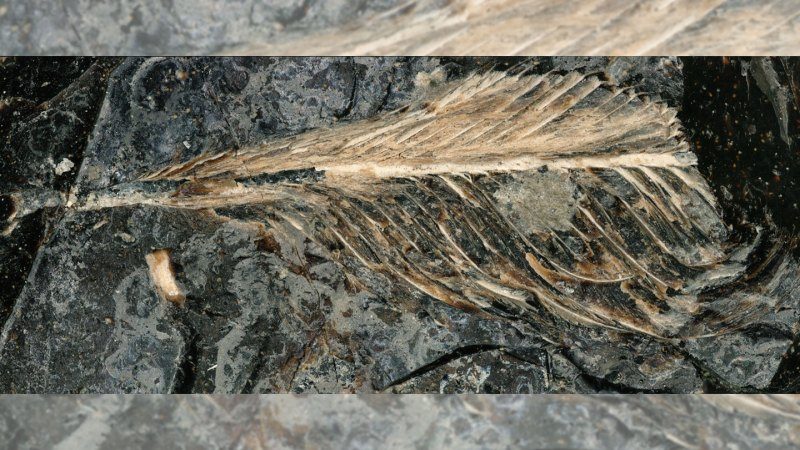
- Preservation: Feathers exhibit exquisite preservation, allowing for detailed analysis of their structure.
- Plumage Characteristics: Some feathers possess dense bristles, potentially offering water repellency similar to modern pelicans. Others show central shafts with air pockets, a trait associated with flight in modern birds.
- Dietary Clues: Micro-CT scans of the coprolite revealed leg bones and fish scales, indicating the bird was aquatic and had recently consumed a meal.
- Avian Group: The feathers are believed to belong to a hesperornithiform, an extinct group of aquatic, toothed birds.
- Extinction Hypothesis: The presence of both modern-looking and more primitive, stringy feathers suggests potential issues with insulation, which might have contributed to the extinction of this group.
Background
The fossilized dung, or coprolite, was unearthed in 2016 from the Hell Creek Formation in Montana, a geological site renowned for its rich dinosaur fossils. The presence of feathers within the coprolite was not immediately apparent. It was only due to a fortuitous crack on the surface of the specimen that a feather became visible, prompting further investigation. This serendipitous observation led the research team, headed by vertebrate paleontologist Jingmai O’Connor of the Field Museum of Natural History in Chicago, to employ advanced micro-CT scanning technology. These scans allowed for a non-destructive, three-dimensional mapping of the coprolite’s internal contents, revealing the hidden plumage.
Impact Analysis
The structural analysis of the feathers has yielded significant insights. The dense bristles observed on some feathers suggest an adaptation for water repellency, a crucial trait for aquatic birds like the hesperornithiforms. This characteristic is comparable to that found in modern pelicans, highlighting a functional convergence across millions of years. Furthermore, the presence of air pockets within the central shafts of other feathers is a key indicator of adaptations for flight. This combination of features, observed for the first time in the Mesozoic Era, provides concrete evidence of the sophisticated plumage developed by some bird ancestors.
“That’s something we’re seeing for the first time in the Age of the Dinosaurs.”
However, the study also points to a potential vulnerability. Alongside feathers resembling those of modern birds, some were found to be more primitive and stringy. Researchers hypothesize that this less efficient feather structure might have compromised the bird’s ability to maintain body heat. This could be a critical factor in understanding differential survival rates during the mass extinction event that occurred approximately 66 million years ago, following the impact of a massive asteroid.
Broader Context
The K-Pg extinction event, which marked the end of the Cretaceous period, led to the demise of roughly 75% of all species on Earth, including all non-avian dinosaurs. While the ancestors of modern birds managed to survive this global catastrophe, many other avian groups, such as the hesperornithiforms, did not. This new discovery offers a compelling hypothesis: that differences in physiological adaptations, specifically the quality of insulation provided by their feathers, may have played a significant role in determining which birds survived the ensuing environmental upheaval. The deep chill and widespread ecological collapse following the asteroid impact would have severely challenged species with poor thermoregulation.
Future Outlook
While this discovery is significant, researchers emphasize the need for further investigation. To solidify the hypothesis linking feather insulation to survival, more fossilized feathers from a diverse range of bird species from the Late Cretaceous period are required. The extreme rarity of fossilized feathers, coupled with the unexpected preservation within coprolites, presents a considerable challenge. However, the success of this study suggests that fossilized dung may be a vastly underestimated source of information about ancient avian life. As Dr. O’Connor noted, “people should start looking.” This opens up a new avenue for paleontological research, potentially yielding more such treasures.
Conclusion
The identification of feathers within fossilized dinosaur droppings is a landmark achievement in paleontology. It not only provides direct evidence of feather structure and potential function in extinct birds but also offers a plausible explanation for the varying fates of avian lineages during the end-Cretaceous mass extinction. The study underscores the importance of seemingly unconventional fossil sources and highlights how subtle biological differences, like the quality of insulation, can have profound evolutionary consequences.
Source: sciencenews.org