US Southwest Megadrought May Be Permanent Due to Human-Caused Climate Shifts
Introduction
The American Southwest is grappling with an unprecedented environmental crisis: a megadrought that has persisted for over two decades, making it the driest period in 1,200 years. The town of Kearny, Arizona, facing an 85 percent cut in its water allotment from the Gila River, exemplifies the dire situation. With its water supply projected to run dry, residents like grocer Norm Warren are confronting the potential collapse of their livelihoods. This crisis, however, may extend beyond a natural cycle of wet and dry years, with emerging research suggesting a more ominous, human-driven cause.
Key Details
- The current megadrought in the US Southwest has lasted 27 years, making it the driest period since 800 AD.
- Rising global temperatures, driven by human activity, create a “thirsty atmosphere” that exacerbates dryness.
- A controversial study posits that human emissions have disrupted the Pacific Decadal Oscillation (PDO), a natural climate cycle influencing Southwest weather.
- The PDO's natural shift to a cool phase, historically bringing drought, may have been unnaturally prolonged by greenhouse gases and aerosols.
- Even if the PDO were to shift back to a warm phase, simulations suggest the Southwest will not return to the wetter conditions of the late 20th century.
- Communities are urged to implement robust water conservation and infrastructure improvements in anticipation of a permanently drier climate.
Background
For decades, scientists have attributed the Southwest's intensifying dryness to a combination of rising temperatures and reduced precipitation. Climate change, driven by human activities, heats the atmosphere, increasing its capacity to hold moisture and thus drying out the land more effectively. This phenomenon, quantified by the Clausius-Clapeyron equation, means that for every degree Celsius of warming, the air can hold 7 percent more water. This “warm drought” is distinct from historical dry periods. Researchers like Kevin Anchukaitis of the University of Arizona Laboratory for Tree-Ring Research analyze ancient tree rings, which serve as a millennium-long record of climate conditions. These records reveal that while megadroughts have occurred before, the current one is exceptionally severe and characterized by higher temperatures.
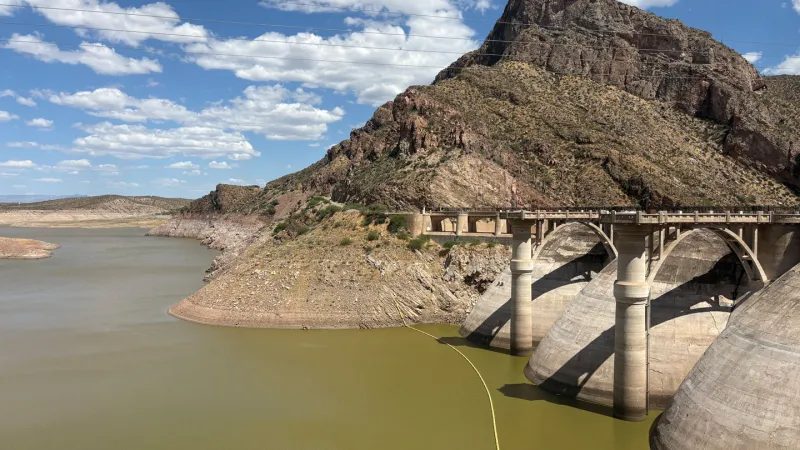
The Colorado River, a vital artery for 40 million people, has seen its flow decrease by approximately 20 percent since 2000. Reservoirs like Lake Powell and Lake Mead have hit historic lows, prompting federal authorities to implement significant water usage cuts for Arizona, California, and Nevada, with potential for further reductions if conditions do not improve. While agriculture is expected to absorb the brunt of these cuts, urban populations may face escalating water bills.
Impact Analysis
The implications of this prolonged aridification are profound. The town of Kearny’s struggle for water is a microcosm of the challenges facing the entire region. With its primary water source, the Gila River, severely depleted due to low snowpack, the town faces a critical water shortage. The potential closure of businesses like Norm Warren’s grocery store, which relies on consistent water for refrigeration, highlights the economic devastation that could accompany water scarcity. Beyond immediate survival, the long-term economic viability of agriculture and other water-dependent industries is under threat.
The federal government’s water allocation cuts underscore the severity of the situation. Planned reductions of 20 percent over the next two years, with potential increases to 40 percent, signal a fundamental shift in water management for the Southwest. These cuts will ripple through communities, impacting everything from food production to urban development. The shift from “drought” to “aridification” reflects a growing scientific consensus that this is not a temporary dry spell but a potentially permanent change in the region's climate.
Broader Context
A significant development in understanding this crisis comes from research into the Pacific Decadal Oscillation (PDO). The PDO is a natural climate pattern characterized by shifts in sea surface temperatures in the Pacific Ocean, influencing weather patterns across North America over decades. Historically, the PDO’s warm phase brought wetter conditions to the Southwest, while its cool phase led to drought. The Southwest experienced a prolonged wet period from 1977 to 1998, coinciding with the PDO’s warm phase.
However, a controversial hypothesis, supported by studies published in journals like Nature and AGU Advances, suggests that human activities, specifically the emission of greenhouse gases and aerosols, have disrupted the natural cycle of the PDO. Researchers like Jeremy Klavans of the University of Miami analyzed hundreds of climate model simulations and found that rising greenhouse gas levels, coupled with decreasing aerosol emissions due to clean air legislation, may have unnaturally prolonged the PDO’s cool phase, locking the Southwest into drought conditions since 1999. This suggests that the current megadrought is not merely a natural fluctuation but a consequence of anthropogenic climate change interfering with a fundamental climate regulator.
“Even if the current El Niño is strong enough to force the PDO into a warm phase, no one should expect the megadrought to go away any time soon. We’re talking about something that’s been going on for a few decades now. Even one very wet winter is not going to be enough to restore Colorado River reservoirs to where they would preferably be.”
Future Outlook
The outlook for the American Southwest remains challenging, even under optimistic scenarios. Climate scientists like Brad Udall of Colorado State University warn that even if greenhouse gas emissions ceased today, the accumulated carbon dioxide in the atmosphere could keep the PDO locked in its cool phase for decades, perpetuating aridification. Studies simulating future climate scenarios, such as those published in npj Climate and Atmospheric Science, indicate that even if the PDO shifts to a warm phase, the Southwest is unlikely to return to the historically wet conditions of the 1980s and 1990s. Instead, the region faces a permanently drier climate.
This projected aridification poses significant challenges for a region with a rapidly growing population. States like Utah, Texas, Nevada, Colorado, and Arizona are among the fastest-growing in the U.S. The increasing demand for water, coupled with decreasing supply, necessitates urgent adaptation strategies. Improved water conservation, efficient infrastructure, and potentially rethinking development patterns will be crucial for the region’s resilience.
Conclusion
The megadrought gripping the American Southwest is more than just a severe weather event; it may represent a fundamental, human-induced shift in the region's climate. The hypothesis that anthropogenic emissions have disrupted the Pacific Decadal Oscillation suggests that the current dry spell could be prolonged indefinitely, transforming the Southwest into a permanently arid landscape. While natural variability plays a role, the overwhelming evidence points to human activities as the primary driver of this escalating crisis. Communities like Kearny are on the front lines, facing existential threats to their water supply and way of life. Preparing for a drier future, through aggressive conservation and adaptive infrastructure, is no longer an option but a necessity for the survival and prosperity of the American Southwest.
Source: sciencenews.org