NASA’s Juno Discovers Unprecedented Plasma Wave Phenomenon Near Jupiter’s Poles
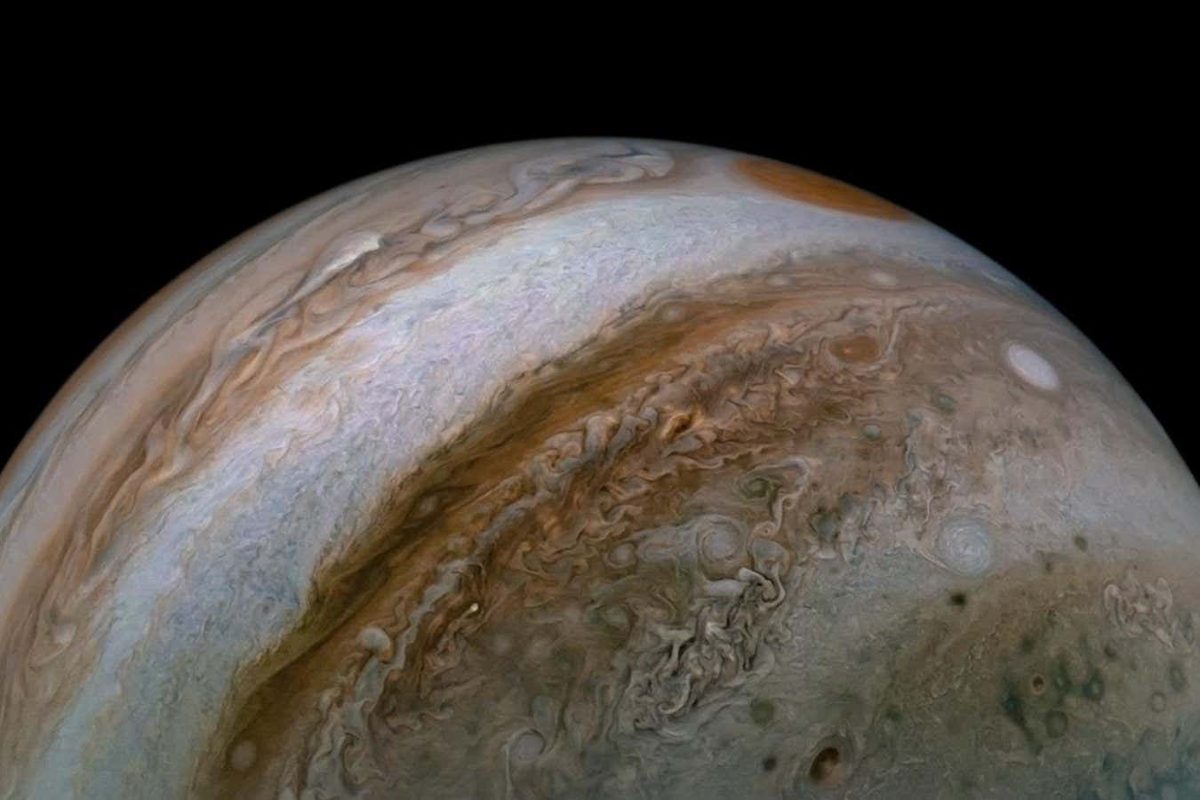
NASA’s Juno Discovers Unprecedented Plasma Wave Phenomenon Near Jupiter’s Poles
Introduction
Recent observations made by NASA’s Juno spacecraft have unveiled a previously unknown type of plasma wave occurring near Jupiter’s polar regions. This discovery represents a significant breakthrough in our understanding of the interactions between Jupiter’s powerful magnetic field and the plasma environment enveloping the planet. It sheds new light on the complex space weather phenomena in the largest planet’s magnetosphere and has important implications for planetary science and plasma physics.
Key Details
- Juno spacecraft detected a novel kind of plasma wave near Jupiter’s poles during its close flybys.
- The waves arise from Jupiter’s intense magnetic field coupled with unique plasma properties in the region.
- This plasma wave is unlike any previously observed in the solar system, representing a new category of extraterrestrial wave phenomena.
- The discovery was made possible by Juno’s suite of advanced instruments designed to study the magnetic and plasma environment of Jupiter.
- Findings offer deeper insight into energy transfer processes in planetary magnetospheres.
Background
Jupiter, the largest planet in the solar system, possesses an exceptionally strong magnetic field, approximately 20,000 times more powerful than Earth’s. This magnetic field traps charged particles, creating a vast magnetosphere filled with plasma—a hot, ionized gas composed of electrons and ions. Scientists have long studied Jupiter’s magnetosphere to understand how magnetic and plasma interactions drive phenomena such as auroras and radiation belts.
Prior to Juno’s mission, plasma waves observed near planets like Earth and Saturn have been categorized into several well-known types, each associated with specific magnetic and plasma conditions. However, the intense magnetic environment of Jupiter, combined with its rapid rotation and unique plasma sources (including volcanic activity from its moon Io), create complex conditions that challenge existing models.
Analysis
The plasma wave detected by Juno near Jupiter’s poles stands apart due to its unique characteristics, which do not match any known wave types seen elsewhere in the solar system. This suggests that Jupiter’s magnetic and plasma environment can generate novel wave behaviors, likely driven by the planet’s exceptional magnetic strength and the particular composition and dynamics of its plasma.
Understanding this new plasma wave is vital because such waves can influence the acceleration and transport of charged particles within Jupiter’s magnetosphere, affecting phenomena like radiation belts and auroral activity. Since plasma waves mediate energy transfer and particle dynamics in space, discovering a new wave type opens avenues to refine theoretical models of magnetospheric physics, not only for Jupiter but potentially for other astrophysical environments.
Additionally, these findings illustrate the value of in-situ spacecraft missions like Juno, which provide direct measurements essential for uncovering subtle and complex plasma processes that remote sensing cannot capture. As Juno continues its mission, further observations may reveal how this plasma wave evolves over time and interacts with Jupiter’s dynamic magnetospheric environment.
Conclusion
The revelation of a completely new type of plasma wave near Jupiter’s poles marks a milestone in planetary science and space plasma physics. It enriches our understanding of how extreme magnetic environments shape wave phenomena and particle dynamics in planetary magnetospheres. These insights not only advance knowledge about Jupiter itself but also contribute to the broader understanding of plasma behavior in space, which is fundamental to interpreting cosmic processes across the universe.
Future work will focus on characterizing the properties and effects of this wave in greater detail, leveraging Juno’s ongoing data stream. This discovery underscores the continuing importance of exploratory missions in expanding the frontiers of knowledge about our solar system’s most enigmatic worlds.