Ancient Interstellar Comet 3I/ATLAS Offers Glimpse Into Early Universe
Introduction
The discovery of interstellar objects passing through our solar system has opened a new frontier in astronomical research. Among these, the comet designated 3I/ATLAS stands out due to its extraordinary origin. Recent studies suggest that this comet came from a star system that formed more than 8 billion years ago—nearly double the age of our Sun. This remarkable finding not only challenges our understanding of cometary formation but also offers a rare opportunity to study material from the early universe.
Key Details
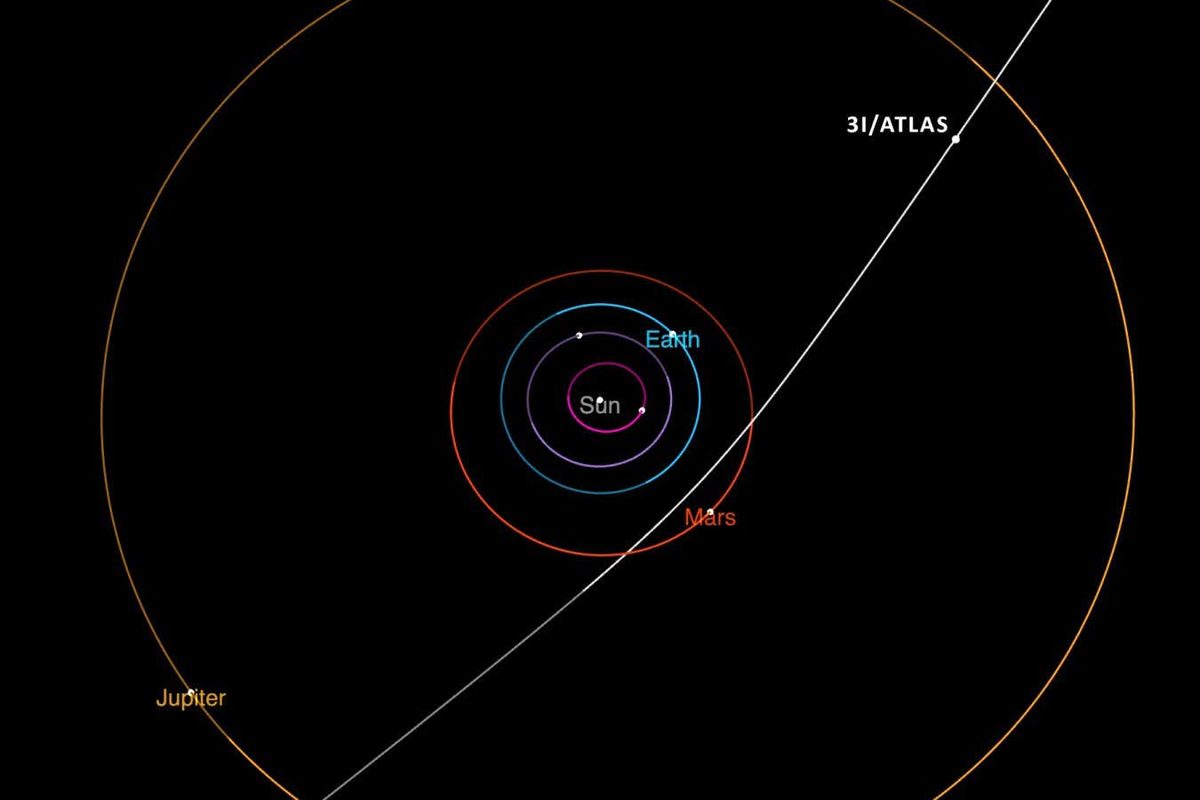
- Object Identification: 3I/ATLAS is an interstellar comet, meaning it originated outside our solar system and is on a hyperbolic trajectory.
- Age of Source Star: Astronomers estimate the comet's home star to be at least 8 billion years old, compared to the Sun’s 4.6 billion years.
- Trajectory and Composition: Its velocity and path confirm its interstellar nature, while spectral analysis reveals unique chemical signatures.
- Scientific Importance: Provides a direct sample of ancient cosmic material, offering clues about conditions in the early galaxy.
Background
Interstellar visitors are rare but invaluable for expanding our knowledge of the cosmos beyond the confines of the solar system. The first confirmed interstellar object, ‘Oumuamua, was detected in 2017, followed by comet 2I/Borisov in 2019. These objects have distinct orbital paths indicating they are not gravitationally bound to the Sun. 3I/ATLAS continues this trend but distinguishes itself by likely originating from an older star, which suggests it may carry primordial materials formed billions of years ago. This contrasts with the relatively young solar system materials we have studied so far.
Comets, often described as "dirty snowballs," contain ice, dust, and organic compounds, preserving the original ingredients of star and planet formation. Observing an interstellar comet such as 3I/ATLAS allows scientists to directly sample materials shaped in a different part of the Milky Way, under possibly very different environmental conditions.
Analysis
The age of 3I/ATLAS’s parent star has profound implications for astrophysics and cosmochemistry. Stars older than the Sun formed when the universe was younger and less chemically enriched. This means the comet could contain simpler or more primordial chemical compounds, potentially shedding light on the evolution of matter in our galaxy. Understanding these differences can inform models of star and planet formation, as well as the distribution of organic molecules necessary for life.
Moreover, the comet’s trajectory and velocity help astronomers trace back its origin, providing clues about the dynamics of old star systems and their ability to eject material into interstellar space. This contributes to ongoing debates about how common interstellar objects are, how they travel through the galaxy, and the processes that send them into our neighborhood.
Additionally, the study of 3I/ATLAS complements ongoing missions and telescopic surveys aimed at detecting and characterizing near-Earth objects and interstellar visitors. Each new discovery refines our understanding of the solar system’s place within the galaxy and of the broader cosmic environment.
Conclusion
The interstellar comet 3I/ATLAS represents a unique cosmic messenger from an ancient star system, offering invaluable data about the early universe’s chemistry and dynamics. As astronomical techniques improve, studying such objects promises to deepen our understanding of the galaxy’s history and the fundamental processes that shaped our own solar system. This discovery is a reminder of the vast and dynamic universe that extends far beyond our celestial neighborhood, waiting to be explored and understood.