Adult T. rex Walked at a Brisk Human Pace, New Footprints Reveal
Introduction
Paleontology has long sought to understand the lives of extinct giants, and new discoveries continue to shed light on their behavior. Recently, a remarkable set of fossilized footprints has provided scientists with an unprecedented glimpse into the movement of an adult Tyrannosaurus rex. This discovery, detailed in the Journal of Vertebrate Paleontology, marks the first time a trackway definitively attributed to an adult T. rex has been found, offering crucial data on its locomotion and walking speed.
Key Details
- Discovery Location: Hell Creek Formation, North Dakota, USA.
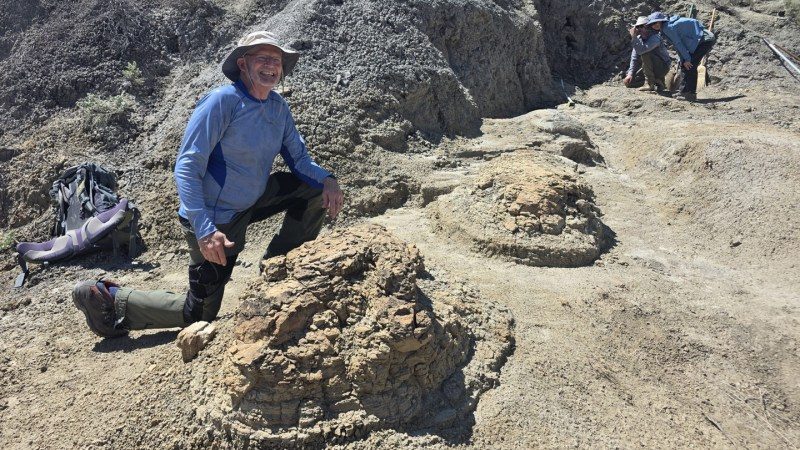
- Footprint Characteristics: Four distinct, large, three-toed footprints measuring approximately 80 centimeters across, forming a trackway.
- Estimated Age: Approximately 66.5 million years old, dating to the Late Cretaceous period.
- Attribution: Believed to be left by an adult Tyrannosaurus rex, based on size and comparison with known fossil evidence in the area.
- Calculated Speed: Estimated walking speed of about 1.6 meters per second (approximately 5.8 kilometers per hour or 3.6 miles per hour).
- Discovery Context: Found by high school teacher and paleontologist Kent Hups while fossil hunting on a steep incline.
Background
While individual T. rex footprints have been unearthed before, and trackways from juvenile T. rex or other dinosaur species are known, a complete trackway from an adult specimen has remained elusive until now. Dr. Peter Falkingham, a paleontologist at Liverpool John Moores University, England, emphasizes the significance of trackways over isolated prints. “An individual track doesn’t tell you a lot,” he explains. “A trackway tells you more about foot placement as the animal’s moving along.” He further notes that, much like humans, younger and older dinosaurs likely exhibited different gaits. The rarity of adult T. rex trackways underscores the importance of this find, offering a unique window into the behavior of these formidable predators in their natural environment.
Impact Analysis
The most striking finding from this trackway is the estimated walking speed of the adult T. rex. At approximately 1.6 meters per second, the dinosaur was moving at a pace comparable to a brisk human walk. This challenges some preconceived notions of T. rex as perpetually lumbering or aggressively fast. While the study acknowledges the inherent difficulties and potential inaccuracies in estimating speed from fossilized tracks, the calculation provides a valuable baseline. The stride length and the size of the footprints were used to derive this speed. However, the preservation quality of the tracks means the actual speed could have been slightly faster or slower. Further analysis of the track details, such as how the foot landed (flat or heel-first) and the pressure distribution, could refine these estimates, but such details are not clearly discernible in these particular prints.
“Finding an adult trackway is cool. It’s unique. It brings something new.”
Broader Context
The Hell Creek Formation in North Dakota is renowned for its rich fossil record, particularly from the Late Cretaceous period, and is famous for yielding numerous T. rex fossils. The discovery by Kent Hups, a high school teacher and paleontologist, highlights the contributions that dedicated amateurs and educators can make to scientific research. The footprints themselves are preserved due to the geological process where sediment filled the original mud impressions, and this infill eroded more slowly than the surrounding rock, leaving the tracks elevated. The presence of slender toe impressions and associated fossil finds in the vicinity strongly support the attribution to T. rex, although the researchers, including Falkingham, cautiously acknowledge the theoretical possibility of an unknown species being responsible. However, based on current knowledge, T. rex is the most plausible candidate.
Future Outlook
The discovery is not necessarily the end of the story. Hups noted that a fifth footprint might be partially concealed within the hillside. The research team is awaiting further natural erosion to reveal any potential additional tracks. The prospect of uncovering more evidence fuels the excitement for future expeditions to the site. Improved preservation of future finds could allow for more detailed biomechanical analyses, potentially revealing nuances in T. rex locomotion, such as the distribution of weight and the mechanics of its gait. This ongoing exploration promises to deepen our understanding of this iconic dinosaur.
Conclusion
This series of adult T. rex footprints represents a significant advancement in our understanding of dinosaur locomotion. The estimated walking speed of 1.6 meters per second provides a tangible comparison to human movement, suggesting that these apex predators were capable of more varied gaits than often depicted. While acknowledging the limitations of fossil track analysis, this unique discovery offers valuable insights into the daily life and movement patterns of the adult T. rex, reinforcing the Hell Creek Formation's importance as a window into the prehistoric world.
Source: sciencenews.org