Jupiter's Polar Mystery: NASA's Juno Discovers Never-Before-Seen Plasma Wave in Gas Giant's Magnetosphere
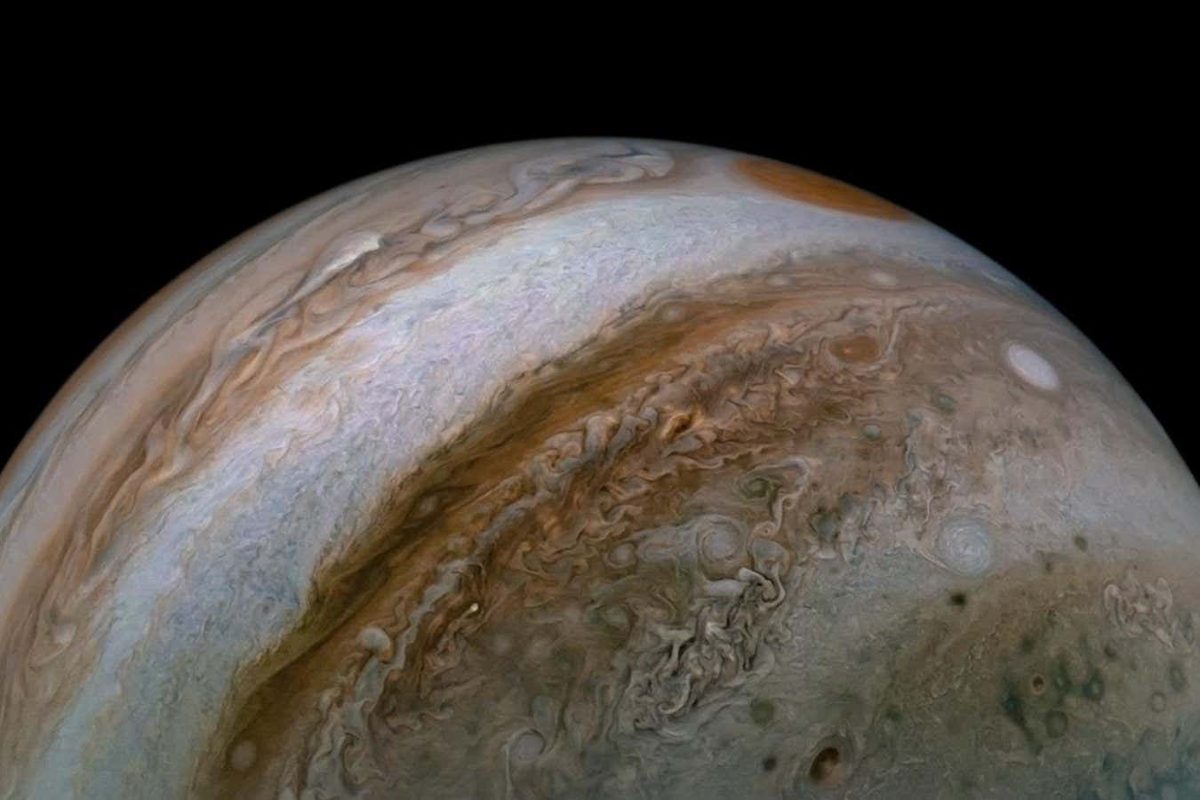
Jupiter's Polar Mystery: NASA's Juno Discovers Never-Before-Seen Plasma Wave in Gas Giant's Magnetosphere
Introduction
In a groundbreaking discovery that could reshape our understanding of planetary magnetospheres, scientists analyzing data from NASA’s Juno spacecraft have identified a previously unknown type of plasma wave in the polar regions of Jupiter. Unlike any wave observed in Earth’s vicinity or in laboratory settings, this phenomenon emerges from the complex interplay between Jupiter’s immensely powerful magnetic field and the charged particles swirling in its upper atmosphere. The detection not only underscores Jupiter’s role as a natural laboratory for extreme physics but also offers new insights into how energy is transferred in space environments dominated by magnetic forces.
Key Details
- Discovery Location: The wave was detected near Jupiter’s north and south poles, where the planet’s magnetic field lines converge.
- Instrumentation: Data came from Juno’s Waves instrument, which measures electric and magnetic radio waves in Jupiter’s magnetosphere.
- Wave Characteristics: The signal exhibits oscillations at frequencies between 1 and 5 hertz, consistent with low-frequency plasma waves, but with a unique polarization and propagation pattern not seen before.
- Driving Mechanism: Scientists believe the wave is generated by interactions between high-energy electrons and ions in Jupiter’s plasma environment, amplified by the planet’s rapid rotation and intense magnetic field.
- Significance: This is the first time such a wave mode has been observed in nature, suggesting a new class of magnetohydrodynamic phenomena in space plasmas.
Background
Jupiter, the largest planet in our solar system, possesses a magnetic field more than 20,000 times stronger than Earth’s, making it the most powerful magnetosphere known. Its rapid rotation—just under 10 hours per day—drags its magnetic field and trapped plasma around at tremendous speeds, creating extreme conditions unlike anything near Earth. The Juno spacecraft, launched in 2011 and arriving at Jupiter in 2016, was specifically designed to study the planet’s polar regions, gravity field, and magnetic environment. Flying in an elongated polar orbit, Juno passes within 4,000 kilometers of Jupiter’s cloud tops, allowing unprecedented close-up measurements.
Plasma waves—oscillations in electrically charged gases—are common throughout space, from the solar wind to Earth’s auroral zones. On Earth, such waves play a crucial role in accelerating particles that cause the northern and southern lights. However, Jupiter’s scale and energy dwarf Earth’s processes. Its auroras are hundreds of times more powerful than ours, fueled not just by the solar wind but also by material ejected from its volcanic moon Io. This constant injection of plasma into Jupiter’s magnetosphere creates a dynamic and turbulent environment ideal for generating exotic wave phenomena.
Analysis
The newly discovered wave appears to be a hybrid mode, combining features of known wave types such as Alfvén waves and kinetic ballooning modes, yet behaving in ways that current models cannot fully explain. Researchers suggest it may be a result of unstable plasma gradients near the polar cusps—regions where magnetic field lines open to space—allowing energy to escape in the form of these waves. Such processes could play a key role in regulating how energy is distributed and dissipated within Jupiter’s magnetosphere, potentially influencing the planet’s intense auroras and radiation belts.
From a broader scientific perspective, this discovery highlights the importance of in-situ measurements in planetary exploration. While simulations and Earth-based observations can predict certain behaviors, the complexity of Jupiter’s system produces phenomena that cannot be replicated in laboratories. Understanding these waves may also have implications for astrophysics, as similar processes could occur around other magnetized bodies, such as brown dwarfs or even neutron stars.
Conclusion
The detection of this novel plasma wave marks a significant advancement in space physics and planetary science. It reaffirms Jupiter as a cornerstone for studying high-energy plasma environments and demonstrates the scientific value of long-duration orbital missions like Juno. As researchers continue to analyze Juno’s vast dataset, more surprises are likely to emerge, further expanding our understanding of the invisible forces that shape the space around giant planets and beyond.