Ancient Mammal Fossil Reveals Reptilian Teeth, Challenging Evolutionary Dogma
Introduction
Paleontologists have unearthed a remarkable fossil in China, shedding new light on the diverse evolutionary paths taken by early mammals. The 120-million-year-old specimen, named Dongoconodon platycauda, presents a mosaic of features that challenge long-standing assumptions about mammalian development. Most strikingly, this semi-aquatic creature possessed teeth that grew and were replaced multiple times throughout its life, a characteristic previously thought to be exclusively reptilian. This discovery, detailed in the journal Nature Communications, suggests that early mammalian evolution was far more varied and experimental than previously understood.
Key Details
- Fossil Discovery: A near-complete fossil of Dongoconodon platycauda, dating back 120 million years, was discovered in Liaoning, China, in 2018.
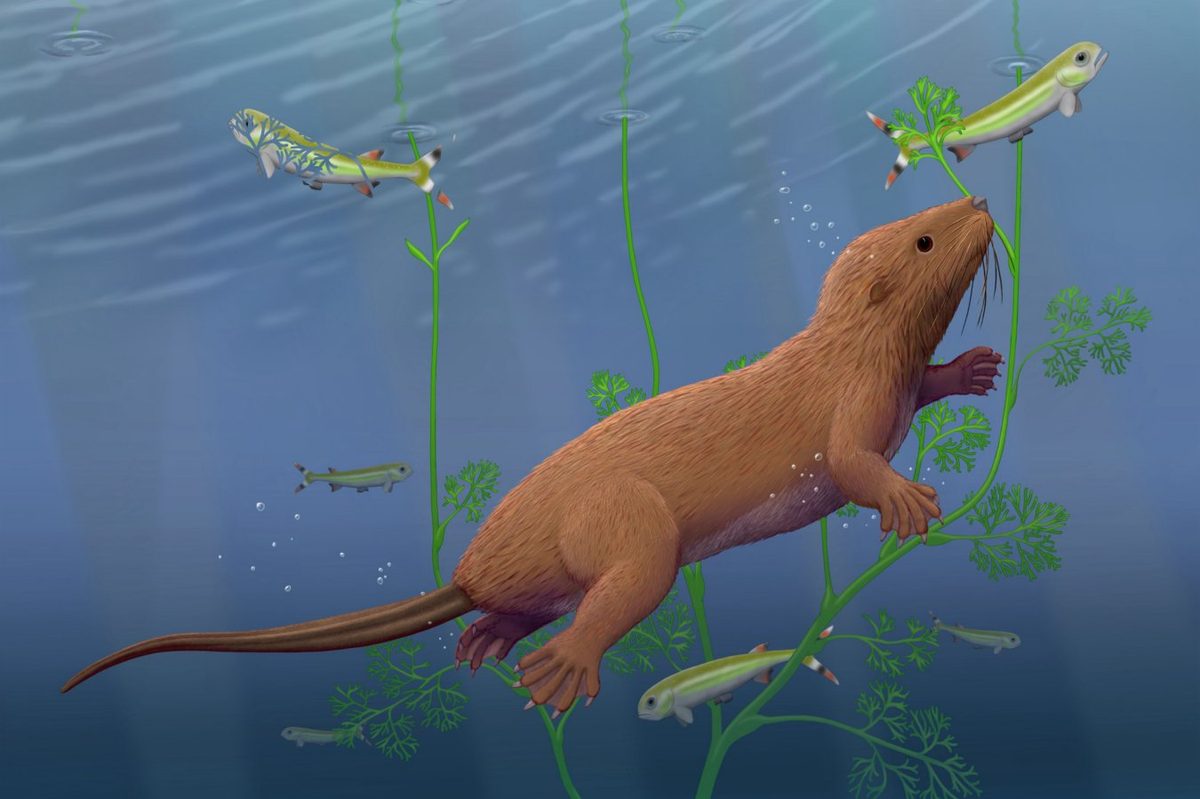
- Physical Characteristics: The mammal was estimated to weigh up to 190 grams and measure around 40 centimeters in length. It had a streamlined, semi-aquatic body, a flattened tail for steering, and broad, webbed feet similar to those of a modern platypus.
- Reptile-like Teeth: Unlike most mammals which replace teeth once (diphyodonty), D. platycauda exhibited polyphyodonty, replacing incisors, canines, premolars, and molars multiple times. This trait is typically associated with reptiles.
- Middle Ear Anatomy: The fossil also preserves one of the most complete middle ear regions known from an Early Cretaceous mammal, showing an intermediate stage in the development of Meckel’s cartilage, which connects the middle ear to the lower jaw.
- Research Team: The study was led by Shundong Bi of Yunnan University, China, with contributions from colleagues and analysis conducted at the Mongolia Museum of Natural History.
Background
For decades, biology textbooks have presented a clear distinction between mammals and reptiles, with one defining characteristic being tooth replacement. Mammals are known for diphyodonty, meaning they develop only two sets of teeth in their lifetime: deciduous (baby) teeth and permanent adult teeth. Reptiles, on the other hand, are typically polyphyodont, continuously replacing their teeth throughout their lives. This fundamental difference has been a cornerstone of understanding vertebrate evolution. Similarly, the evolution of the mammalian middle ear, involving the transformation of reptilian jaw bones into tiny ear ossicles, has been viewed as a tightly integrated evolutionary event.
Impact Analysis
The discovery of Dongoconodon platycauda directly challenges these established paradigms. The presence of polyphyodonty across all four tooth classes in this mammal is unprecedented. It suggests that the evolutionary pathways leading to mammalian characteristics were not monolithic. Instead, different lineages explored diverse strategies, retaining ancestral traits like continuous tooth replacement long after other groups had adopted the mammalian norm. Furthermore, the intermediate state of its middle ear anatomy, with Meckel’s cartilage showing reduced but still present connection to the jaw, indicates that the evolution of the middle ear and jaw structure may have occurred independently or at different rates in various mammal groups.
“Our discovery shows that early mammalian evolution was considerably more flexible than the traditional textbook picture suggests.”
This finding implies that the suite of characteristics we associate with modern mammals—such as precise tooth replacement and a fully detached middle ear—did not evolve simultaneously or uniformly. Instead, there was a period of significant evolutionary experimentation, with some early mammals retaining reptilian-like features while simultaneously developing other mammalian traits.
Broader Context
Dongoconodon platycauda lived during the Early Cretaceous period, a time when dinosaurs dominated the terrestrial landscape. Mammals of this era were generally small and often nocturnal, occupying ecological niches that allowed them to coexist with the giant reptiles. This newly described mammal, with its semi-aquatic lifestyle, adds another layer to our understanding of the ecological diversity of Mesozoic mammals. Its adaptations for swimming, including webbed feet and a flattened tail, are reminiscent of modern semi-aquatic mammals like the platypus and nutrias, demonstrating convergent evolution in aquatic environments.
Future Outlook
The implications of this discovery extend to how we interpret the fossil record and reconstruct evolutionary trees. Future research will likely focus on searching for more fossils that exhibit similar mosaic features, potentially revealing further evidence of evolutionary flexibility. Scientists may need to re-evaluate existing classifications and evolutionary models to accommodate the diversity of traits observed in early mammals. The study of D. platycauda underscores the importance of continued paleontological exploration, particularly in regions like China, which have yielded a wealth of information about the origins and early diversification of life.
Conclusion
The discovery of Dongoconodon platycauda is a significant event in paleontology. It provides compelling evidence that early mammalian evolution was not a simple, linear progression towards modern forms but a complex process involving diverse experiments and the retention of ancestral traits. The reptile-like teeth and intermediate ear anatomy of this 120-million-year-old mammal force a re-evaluation of what defines a mammal and highlight the dynamic nature of evolutionary history during the age of dinosaurs.
Source: newscientist.com