James Webb Telescope Detects Most Distant Fast Radio Burst, Revealing Early Universe Clues
Introduction
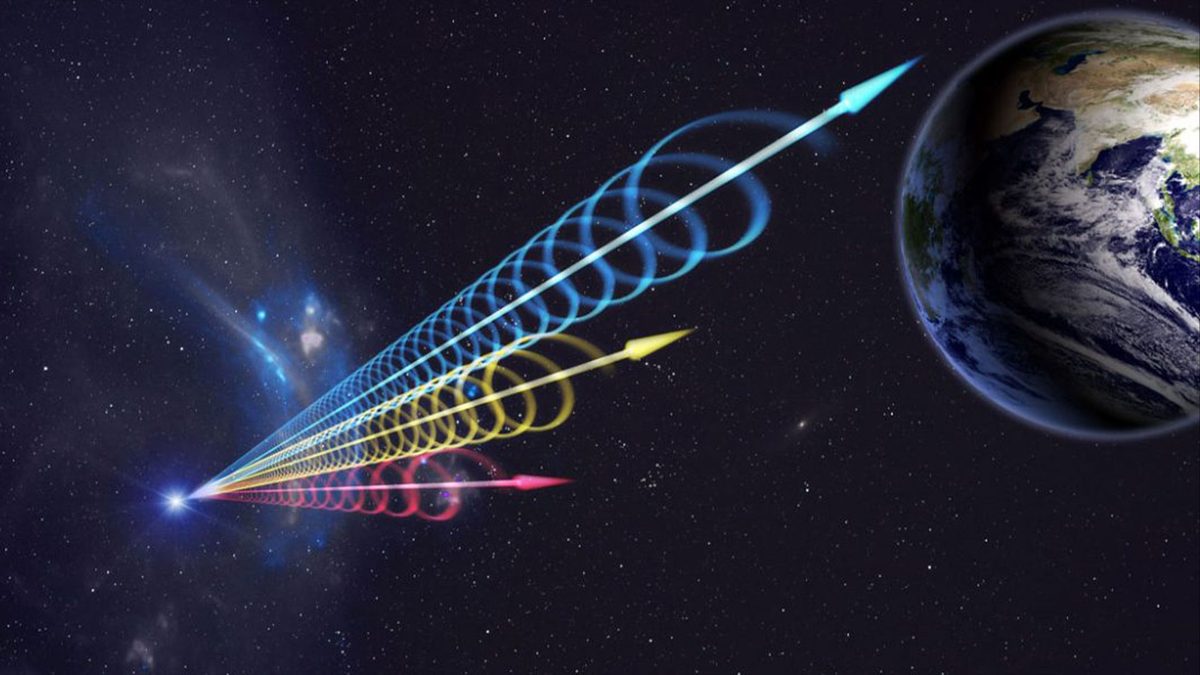
In a groundbreaking discovery, astronomers have utilized the unparalleled capabilities of the James Webb Space Telescope (JWST) to detect the most distant Fast Radio Burst (FRB) ever observed. This enigmatic cosmic signal, designated FRB 20240304B, emanates from a staggering distance of over 10 billion light-years, effectively doubling the previous record and pushing the boundaries of our understanding of the early universe. FRBs, characterized by their millisecond-long, powerful radio emissions, have long puzzled scientists due to their fleeting nature and unclear origins. This latest detection, however, provides crucial clues by pinpointing the burst's host galaxy in an era when the universe was merely three billion years old, about one-fifth of its current age.
Key Details
- Record Distance: FRB 20240304B was detected originating from over 10 billion light-years away, setting a new record for the farthest FRB observed.
- Collaborative Effort: The discovery involved a coordinated effort between the MeerKAT radio telescope array in South Africa and the James Webb Space Telescope.
- Host Galaxy Characteristics: JWST observations revealed the host galaxy to be smaller than anticipated, "metal-poor" (containing few elements heavier than hydrogen and helium), and actively forming a high rate of stars.
- Early Universe Insight: The detection provides a glimpse into the universe when it was approximately three billion years old, suggesting FRBs were present early in cosmic history.
- Potential Source: Researchers hypothesize that FRB 20240304B may be linked to a magnetar, a highly magnetized neutron star remnant of a supernova, which are more common in young, star-forming galaxies.
- Publication: The findings were published in the journal Science.
Background
Fast Radio Bursts (FRBs) are intense, millisecond-duration flashes of radio waves originating from deep space. While thousands of FRBs have been detected since their discovery in 2007, their precise origins remain one of modern astrophysics' most significant mysteries. Their short duration makes them incredibly difficult to study, often leaving astronomers with only a general location in the sky. The distance to an FRB is typically estimated by measuring the dispersion of its radio signal – how much the different radio frequencies have spread out during their journey through space. A larger dispersion indicates a longer path through the intergalactic medium, implying a greater distance. However, pinpointing the exact source galaxy, especially for very distant FRBs, has been a major challenge.
Impact Analysis
The significance of FRB 20240304B lies not only in its record-breaking distance but also in the detailed information gathered about its host galaxy. Initial detection by MeerKAT provided a precise location, but ground-based telescopes were unable to resolve the faint host galaxy. This is where the JWST proved transformative. Its powerful infrared vision allowed astronomers to pinpoint a faint galaxy precisely where the FRB signal originated. Spectroscopic analysis by JWST revealed the galaxy's composition and star formation rate. The finding that this ancient galaxy was metal-poor and forming stars rapidly aligns with theories suggesting that magnetars – highly magnetized neutron stars – are the progenitors of at least some FRBs. Magnetars are thought to be more prevalent in the energetic, early stages of galactic evolution. This discovery thus strengthens the link between FRBs and these extreme stellar objects, offering a tangible pathway to understanding their formation mechanisms.
“Suddenly, there it was: a very faint galaxy almost exactly where we expected the host of the FRB to be,” said study co-author Themiya Nanayakkara.
Broader Context
This detection places FRBs firmly within the context of the early universe. By observing an FRB from a time when the universe was only about three billion years old, scientists are gaining insights into the conditions and phenomena prevalent in the cosmos shortly after the Big Bang. The presence of such energetic events so early in cosmic history suggests that the processes leading to FRB generation were established relatively quickly. This challenges previous assumptions about the timeline of cosmic evolution and the types of objects that could produce such powerful bursts. The study co-authors, Manisha Caleb and Themiya Nanayakkara from the Sydney Institute of Astronomy, highlight that this discovery opens up new avenues for exploring the universe's formative years, using FRBs as cosmic lighthouses.
Future Outlook
The success of this coordinated observation strategy bodes well for future FRB research. The research team plans to continue leveraging JWST's capabilities to study more FRBs. The synergy between radio telescopes like MeerKAT, which can detect and localize these transient events, and JWST, which can then perform detailed follow-up observations of the host galaxies, is proving to be a powerful approach. “We do not know what the sources will be yet,” Nanayakkara stated, emphasizing the element of surprise and discovery. “Once our radio telescopes find and localize a suitable new source, we can trigger the JWST observations. So it is quite exciting, because we really have no idea what we will find when we combine the power of these two types of telescopes.” This ongoing quest promises to unravel more mysteries surrounding FRBs and provide deeper insights into the evolution of galaxies and the universe itself.
Conclusion
The detection of FRB 20240304B by the James Webb Space Telescope marks a significant milestone in astrophysics. It not only represents the most distant FRB ever recorded but also provides crucial observational evidence linking these mysterious bursts to the conditions of the early universe and potentially to magnetars. The collaborative power of radio and space-based telescopes has unlocked new possibilities for studying cosmic phenomena that were previously beyond our reach. As astronomers continue to hunt for more FRBs and utilize JWST for detailed analysis, we can anticipate further revelations about the universe's most energetic and enigmatic events.
Source: livescience.com