IceCube Breakthrough Sheds Light on Mysterious Ultra-High-Energy Cosmic Rays
IceCube Breakthrough Sheds Light on Mysterious Ultra-High-Energy Cosmic Rays
Introduction
In a landmark development for astroparticle physics, scientists at the IceCube Neutrino Observatory have made significant headway in unraveling one of the most enduring mysteries of the cosmos: the nature of ultra-high-energy cosmic rays (UHECRs). These extraordinarily energetic particles, which strike Earth’s atmosphere from deep space, have puzzled researchers for decades due to their extreme energies—often exceeding 1018 electron volts, and sometimes reaching levels millions of times greater than those achieved in human-made particle accelerators like the Large Hadron Collider. A new analysis leveraging neutrino data from IceCube has now provided crucial evidence about the types of particles that constitute UHECRs, offering clarity on a debate that has divided the scientific community.
Key Details
- IceCube, located at the South Pole, detected neutrinos produced when UHECRs interact with cosmic microwave background radiation.
- The data strongly suggest that UHECRs are primarily composed of heavier atomic nuclei, such as iron, rather than pure protons.
- These findings help reconcile discrepancies between earlier experiments like the Pierre Auger Observatory and the Telescope Array.
- The breakthrough relies on indirect measurements through the detection of secondary neutrinos and muons.
- Despite this progress, the exact astrophysical sources of UHECRs—such as active galactic nuclei or starburst galaxies—remain unidentified.
Background
Ultra-high-energy cosmic rays were first detected in the 1960s, but their origins and composition have remained elusive. Because cosmic rays are charged particles, their trajectories are bent by interstellar and intergalactic magnetic fields, making it impossible to trace them directly back to their sources. Instead, scientists use indirect methods, such as analyzing air showers—cascades of secondary particles produced when cosmic rays collide with atmospheric nuclei. Experiments like the Pierre Auger Observatory in Argentina and the Telescope Array in Utah have collected extensive data on these air showers, but their interpretations of particle mass have conflicted. While Auger data pointed toward heavier nuclei, Telescope Array results aligned more closely with proton-dominated models.
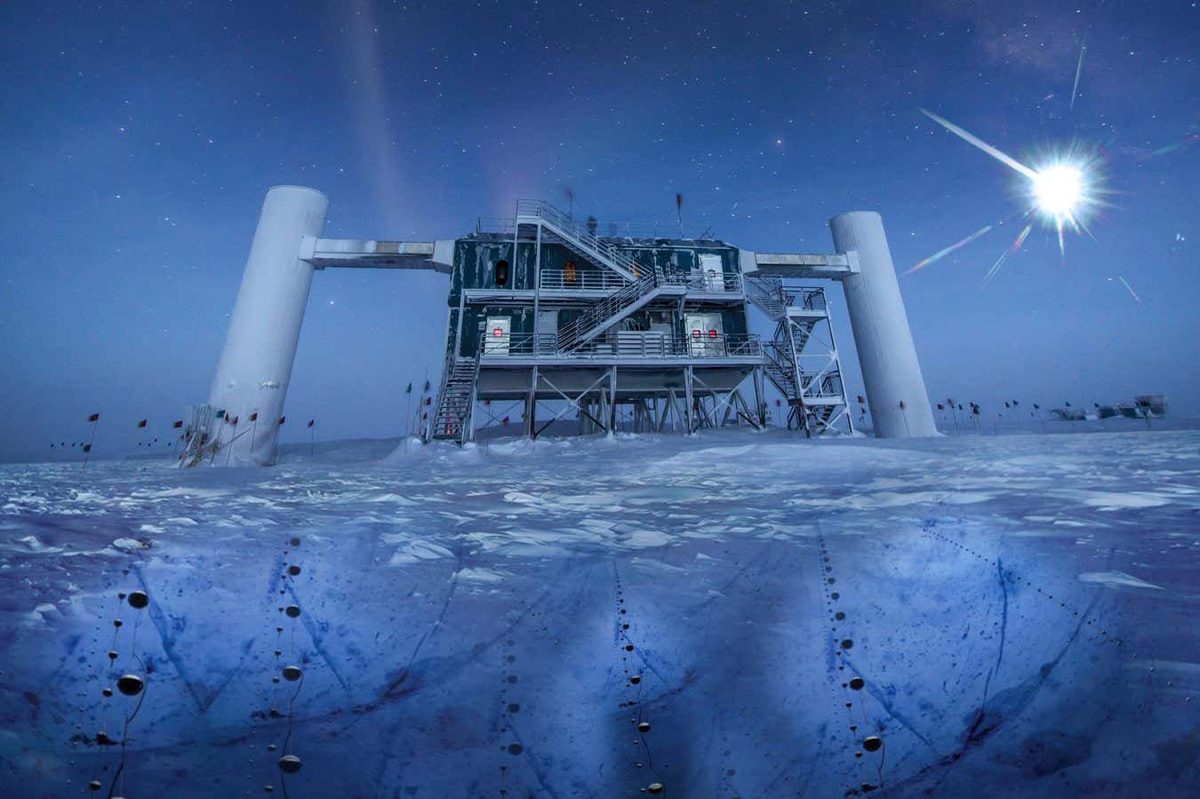
Enter IceCube, a cubic-kilometer detector embedded in Antarctic ice, designed primarily to observe neutrinos—nearly massless, neutral particles that travel unimpeded across cosmic distances. When UHECRs interact with photons from the cosmic microwave background, they produce pions that decay into high-energy neutrinos. By measuring the flux and energy distribution of these so-called cosmogenic neutrinos, IceCube researchers can infer the composition of the parent cosmic rays. This latest analysis, based on over a decade of data, supports the heavier-nuclei hypothesis.
Analysis
The significance of this finding extends beyond mere particle identification. Confirming that UHECRs are mostly heavy nuclei reshapes our understanding of their acceleration mechanisms. Heavy nuclei are more easily stripped of electrons in high-energy environments and require different astrophysical conditions for acceleration compared to protons. This suggests that the sources of UHECRs are likely extreme environments such as the jets of active galactic nuclei or the turbulent regions around starburst galaxies.
Moreover, the resolution of the composition debate may help refine models of cosmic magnetic fields and improve future attempts to pinpoint UHECR sources. While neutrinos offer a cleaner signal than charged particles, their rarity demands long observation times and immense detectors. IceCube’s ability to contribute to cosmic ray science underscores the importance of multimessenger astronomy—the practice of observing the universe using light, gravitational waves, neutrinos, and cosmic rays in concert.
Conclusion
Though the IceCube findings represent a major step forward, many questions remain. Where exactly are these particles being accelerated? How do they survive the journey across billions of light-years without losing energy? The next generation of observatories, such as the planned IceCube-Gen2 and the AugerPrime upgrade, aims to answer these questions with greater precision. For now, the scientific community celebrates a hard-won resolution to a decades-old puzzle—one that brings us closer to understanding the most energetic phenomena in the universe.