Dinosaur Footprints Reveal 76-Million-Year-Old Multi-Species Herding Behavior
Introduction
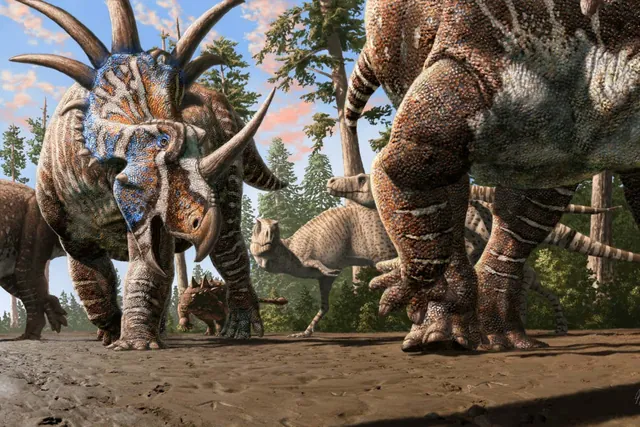
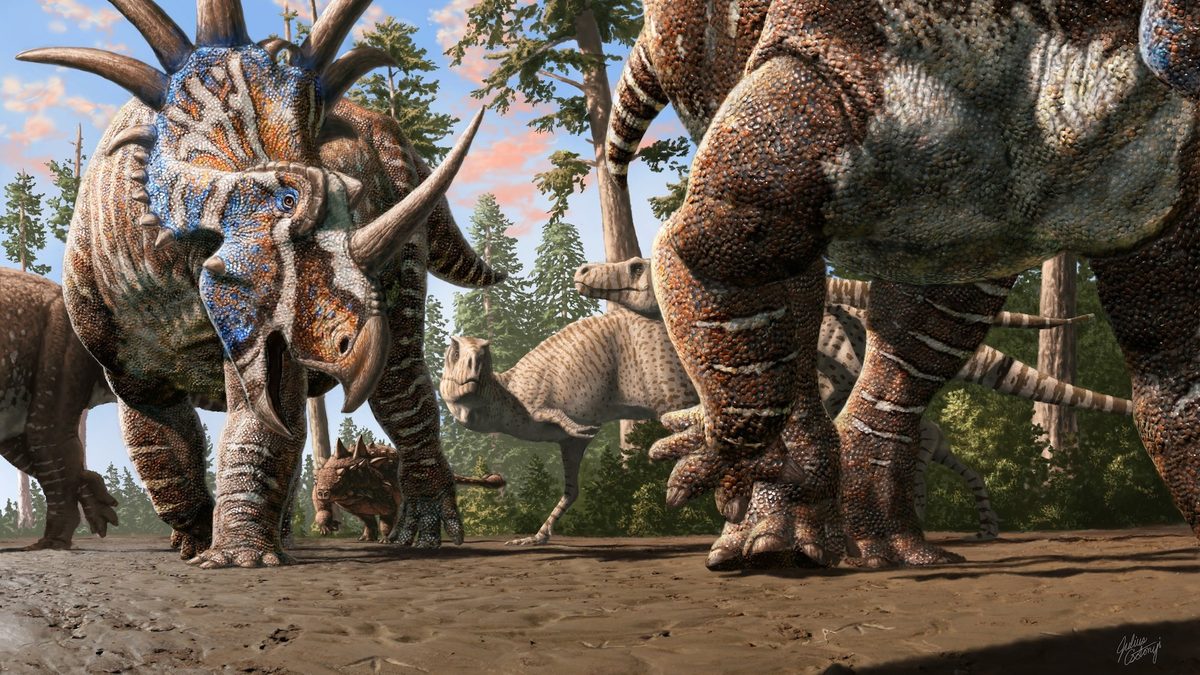
In a groundbreaking discovery that reshapes our understanding of prehistoric animal behavior, paleontologists have uncovered compelling evidence that dinosaurs engaged in multi-species herding—a social strategy previously thought to be a more recent evolutionary development. Fossilized footprints preserved in sediment at Dinosaur Provincial Park in Alberta, Canada, show that at least five species of herbivorous dinosaurs traveled together 76 million years ago during the Late Cretaceous period. This behavior closely mirrors that of modern African savannah animals, such as wildebeest and zebra, which form mixed herds for enhanced protection against predators. The study, published in the peer-reviewed journal PLOS One, marks one of the most direct behavioral insights into dinosaur social dynamics ever recorded.
Key Details
- Over 20 fossilized footprints were discovered in a 312-square-foot sediment layer in Dinosaur Provincial Park, a UNESCO World Heritage Site.
- The tracks belong to multiple species, including at least five types of ceratopsians (horned dinosaurs), an ankylosaurid (armored dinosaur), and a small, unidentified carnivore.
- Two large tyrannosaurid tracks were found perpendicular to the herd’s path, suggesting possible predation behavior.
- The site dates to approximately 76 million years ago, during the Campanian stage of the Late Cretaceous.
- The research team was led by Phil Bell from the University of New England and Brian Pickles from the University of Reading.
- Findings were published in PLOS One under an open-access model, making data available for global scientific scrutiny.
Background
Dinosaur Provincial Park has long been a treasure trove for paleontologists, yielding over 50 dinosaur species since its designation as a UNESCO World Heritage Site in 1979. However, most discoveries have focused on skeletal remains, with limited attention paid to trace fossils like footprints—until recently. These preserved tracks offer a unique window into dinosaur behavior, capturing moments in time that bones alone cannot reveal. The area was once a lush, subtropical floodplain crisscrossed by rivers flowing into an inland sea, providing a rich ecosystem for diverse dinosaur populations. Unlike today’s cold, rugged Alberta landscape, the region 76 million years ago supported dense vegetation and abundant water sources, ideal for large herbivores.
Impact Analysis
“It was incredibly exciting to be walking in the footsteps of dinosaurs 76 million years after they laid them down,”said Brian Pickles, co-author and paleontologist at the University of Reading. The emotional weight of such a discovery underscores its scientific significance. The presence of multiple ceratopsian species—likely including centrosaurus and chasmosaurus—moving in unison suggests a level of inter-species coordination previously undocumented. Such behavior implies advanced social cognition and possibly shared survival instincts, such as collective vigilance against predators. The proximity of tyrannosaurid tracks introduces a dramatic narrative: a potential predator surveilling a mixed herbivore group. While there is no direct evidence of an attack, the spatial arrangement of the tracks indicates a tense ecological interaction, offering rare behavioral context.
The discovery also challenges long-held assumptions that complex social behaviors evolved only in modern mammals. Instead, it suggests that such traits may have deep evolutionary roots, extending back over 70 million years. This has implications for how scientists model ancient ecosystems and understand the selective pressures that shaped dinosaur evolution. By analyzing stride patterns and trackway spacing, researchers can infer movement speed, group density, and even decision-making processes within these ancient herds.
Broader Context
Modern ecosystems provide useful analogs. In East Africa, mixed-species herds of wildebeest and zebra reduce individual predation risk through increased vigilance and confusion effects during predator attacks. The Alberta fossil site may represent a prehistoric version of this phenomenon. The inclusion of an ankylosaurid—an armored, slow-moving dinosaur—within the herd further strengthens the mutual protection hypothesis, as its physical defenses could have benefited more vulnerable species. Meanwhile, the unidentified small carnivore’s footprint raises questions about scavenging or opportunistic behavior near large herbivore groups.
The study was funded by institutional grants from the University of Reading and the University of New England, with fieldwork supported by Alberta Parks. The use of digital elevation modeling allowed precise mapping of the site, preserving spatial relationships between tracks. This technological integration enhances the reliability of behavioral interpretations.
Future Outlook
The research team has already identified additional promising sites using the same search methodology, indicating that more evidence of dinosaur social behavior may soon emerge. Phil Bell emphasized the importance of expanding footprint surveys, noting that such trace fossils are often overlooked despite their high behavioral value. Future studies may focus on trackway chronology—determining whether these interactions were isolated or part of recurring patterns—and investigating potential communication mechanisms between species.
Conclusion
This discovery fundamentally alters our perception of dinosaur society. No longer seen as solitary or narrowly social creatures, dinosaurs appear to have formed complex, interdependent communities millions of years before similar strategies emerged in mammals. The 76-million-year-old footprints from Alberta offer not just fossilized impressions in mud, but enduring evidence of cooperation, survival, and ecological sophistication in the age of dinosaurs.