8-Bit Mechanical Computer Built from 10,000+ Knex Pieces Performs Calculations Without Chips
Introduction
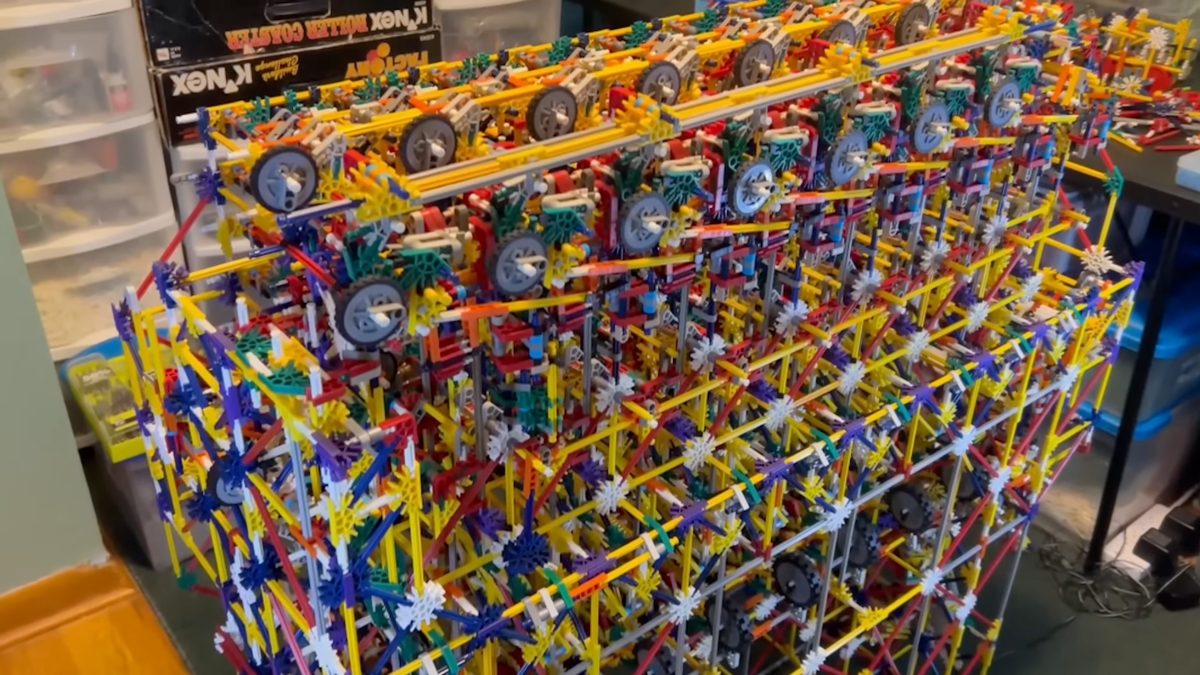
In an age dominated by silicon-based microprocessors and cloud computing, a surprising innovation has emerged from an unexpected source: children’s construction toys. YouTuber Shadowman39 has built a fully functional 8-bit mechanical computer using more than 10,000 Knex pieces—plastic rods and connectors typically used for building simple models. This intricate machine, standing at approximately 3.5 feet tall, performs basic arithmetic operations such as addition and subtraction entirely through mechanical means. While it lacks the speed and efficiency of modern digital computers, the device serves as a powerful educational model, demonstrating the foundational principles of computing in a tangible, visually compelling way.
Key Details
- The mechanical computer is built using over 10,000 Knex components, including wheels, conveyor belts, and rack-and-pinion mechanisms.
- It operates as an 8-bit system, capable of representing values from 0 to 255 in unsigned form or -128 to 127 in signed binary using two’s complement.
- Each of the eight vertical columns represents one bit of binary data, with physical positions indicating 0s and 1s.
- Though powered initially by an electric motor, all calculations are executed mechanically through gears and levers—no electronic processors are involved.
- The Arithmetic Logic Unit (ALU), the core of the computer, is currently capable of basic operations like addition and subtraction.
- Shadowman39 plans to expand the system to include mechanical RAM and ROM for data and program storage in future builds.
Background
Mechanical computing is not a new concept. Historically, devices like the Antikythera mechanism, discovered in a shipwreck off the coast of Greece and dated to around 100 BCE, were used to predict astronomical positions and eclipses. Centuries later, 19th-century inventors such as Charles Babbage designed complex mechanical computers like the Difference Engine, though few were completed in his lifetime. In the 20th century, mechanical calculators like the Soviet Union’s Ascota 170 were used for accounting and engineering tasks well into the 1960s.
Shadowman39’s project draws direct inspiration from these analog ancestors. However, instead of precision-machined metal gears, he uses mass-produced plastic Knex parts—materials associated more with playgrounds than computation. This choice underscores a growing trend in maker culture: using accessible, low-cost materials to recreate complex scientific and engineering concepts. His past projects include mechanical coin sorters and a full-scale Skee-Ball machine, all built from Knex, showing a long-standing commitment to pushing the limits of toy-based engineering.
Impact Analysis
“It looks like a mess but I promise it’s just organized chaos,”says Shadowman39 in his video, gesturing toward the web of moving parts. Indeed, the machine appears chaotic at first glance—conveyor belts whir, rods shift, and gears rotate—but every motion is purposefully designed. The computer translates binary logic into physical movement: a raised lever might represent a “1,” while a lowered one signifies a “0.” When a calculation begins, the user inputs two numbers, and the system mechanically processes them through a series of rotations, transfers, and resets across the eight columns.
The use of rack-and-pinion systems allows for precise linear motion, essential for accurate bit representation. Counterweights stabilize the structure during operation, preventing collapse under its own mechanical strain. While the process takes several seconds per operation—far slower than any digital device—it provides a visually intuitive understanding of how binary arithmetic works. This makes the device an exceptional teaching tool for students learning about computer architecture, digital logic, and the history of technology.
Broader Context
The Knex computer taps into a resurgence of interest in mechanical computation, fueled by educators, hobbyists, and engineers alike. In classrooms, such models help demystify abstract concepts like binary representation, carry operations, and logic gates. Unlike digital simulations, physical machines engage multiple senses, reinforcing learning through touch and observation. Moreover, the project highlights the ingenuity required to perform computing without electricity or semiconductors—offering insight into how early computers functioned before the digital revolution.
It also reflects a broader cultural movement toward open-source, hands-on learning. Shadowman39 shares his progress through YouTube, allowing viewers to follow the design process in real time. This transparency encourages replication and collaboration, embodying the spirit of the modern maker movement. While the computer is not intended for commercial use, its design philosophy aligns with initiatives like DIY robotics and retrocomputing, where enthusiasts rebuild historical systems to understand their inner workings.
Future Outlook
Shadowman39 has stated that this is only the beginning. He plans to integrate mechanical memory systems—both RAM and ROM—using rotating drums or punch-card-like mechanisms to store data and instructions. This would allow the computer to execute simple programs autonomously, marking a significant leap from manual input to programmable operation. If successful, the full system could demonstrate not just arithmetic, but conditional logic and looping—core features of modern computing.
Such advancements would place the Knex computer in a rare category of educational models that simulate full computational cycles. While still far from practical application, the project could inspire similar builds using other modular systems like LEGO or Meccano, potentially leading to standardized mechanical computing kits for STEM education.
Conclusion
Shadowman39’s 8-bit Knex computer is more than a novelty; it’s a testament to human creativity and the enduring principles of computation. By reducing the abstract world of binary code to gears, levers, and plastic rods, the inventor makes the invisible visible. Though it won’t replace your laptop, it offers something equally valuable: a deeper appreciation for the engineering marvels that underlie even the simplest digital operations. In a world increasingly driven by invisible software and microscopic transistors, this mechanical marvel reminds us that computation, at its core, is fundamentally a physical process.