Czech Republic Discovery: 6,500-Year-Old Ritual Site Predates Stonehenge by a Millennium
Introduction
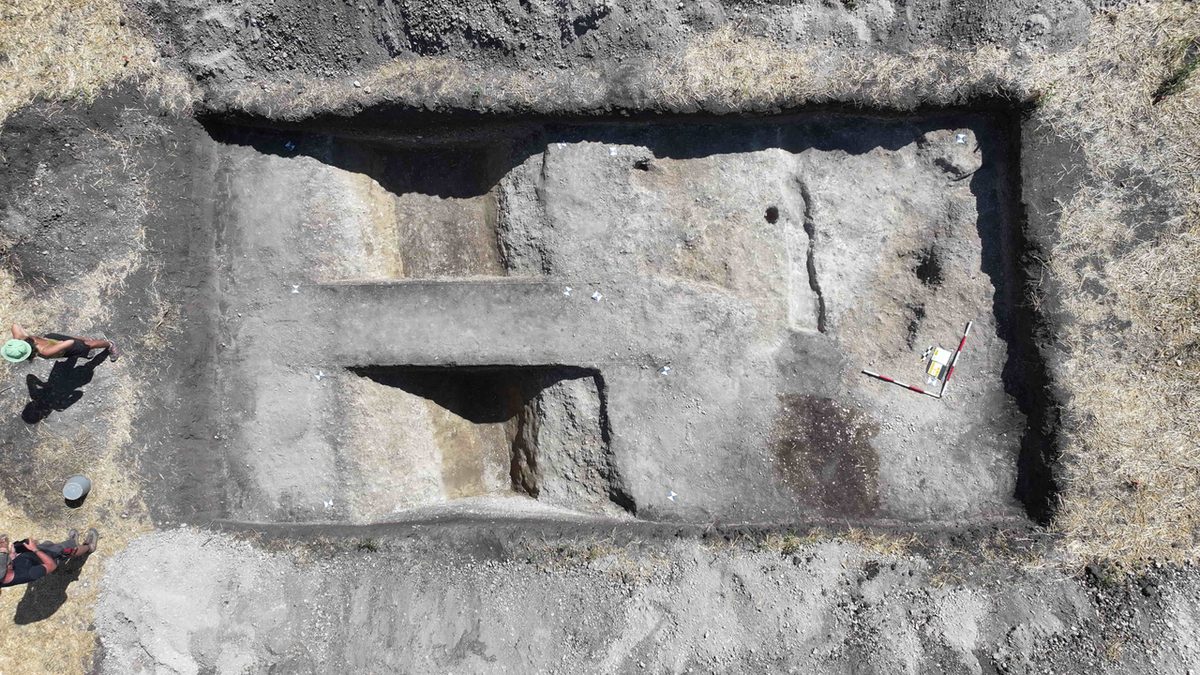
In a discovery that pushes back the timeline of complex prehistoric ritualistic practices in Europe, archaeologists in the Czech Republic have unearthed a remarkable structure dating back approximately 6,500 years. Located at Chleby in the Central Bohemian Region, this ancient site predates the iconic Stonehenge in England by roughly a millennium, offering a tantalizing glimpse into the sophisticated astronomical knowledge and spiritual beliefs of early farming communities.
Key Details
- Discovery Location: Chleby, Central Bohemian Region, Czech Republic.
- Age: Approximately 6,500 years old, placing it in the Neolithic period.
- Structure: A large circular enclosure defined by a ditch measuring about 750 feet (230 meters) in diameter and 8 feet (2.5 m) deep.
- Entrances: Twelve distinct entrances led into the enclosure, strategically positioned around the ditch.
- Potential Construction: Wooden posts are suspected to have formed the enclosure walls.
- Ritualistic Elements: Evidence suggests bull skulls and horns may have adorned the entrances, reflecting the importance of the bull as a symbol of strength and fertility in Neolithic cultures.
- Astronomical Alignment: The 12 entrances are precisely oriented to observe significant solar and lunar events, including the summer solstice sunrise, winter solstice sunset, and the extreme positions of the moon in its 18.6-year cycle.
- Later Use: The site later saw burials from the Bronze Age Únětice culture and was eventually covered by an Iron Age settlement, indicating a shift in its significance over millennia.
Background
The unearthed structure at Chleby represents a significant find for understanding early European societies. Unlike typical circular enclosures found in the region for this period, the Chleby site is exceptional due to its scale and, more importantly, its deliberate astronomical orientation. The research team, led by Professor Petr Krištuf of the University of West Bohemia, meticulously analyzed the positioning of the twelve entrances. Their findings revealed a sophisticated geometric system designed for observing key celestial events. This suggests a deep understanding of astronomical cycles and their integration into the spiritual and social life of the community.
The presence of bull imagery, such as skulls and horns, at the entrances further enriches our understanding of the site's ritualistic purpose. As explained by archaeologist Jan Turek of Charles University, the bull was a potent religious symbol for early farming communities across prehistoric Europe, embodying concepts of strength and fertility. This connection underscores the vital role of agriculture and the natural world in shaping the spiritual landscape of these ancient peoples.
Impact Analysis
The discovery of the Chleby structure has profound implications for our understanding of Neolithic European societies. It challenges previous assumptions about the technological and intellectual capabilities of these early communities. The precise astronomical alignments indicate a level of scientific observation and calendrical knowledge that is far more advanced than previously attributed to this era. The comparison drawn by Professor Krištuf to Stonehenge, noting similar design principles in the orientation of its main axis, suggests that such celestial observatories were not isolated phenomena but perhaps part of a broader cultural tradition across Europe.
“For prehistoric farming communities, the connection between sunrise and the summer solstice symbolized a beginning, while sunset and the winter solstice represented an ending. The same principle can be seen along Stonehenge's main axis. We can now see that [this site] was designed similarly.”
The dual alignment with both solar and lunar cycles is particularly noteworthy. While solar observations, especially solstices, were crucial for agricultural planning, the inclusion of lunar observations, such as the moon’s extreme positions, points to a more complex cosmological worldview. This suggests that the community’s understanding of time and the cosmos extended beyond immediate agricultural needs, possibly encompassing a broader spiritual or mythological framework.
Broader Context
The Chleby site emerges within a growing body of evidence highlighting the sophistication of prehistoric cultures in Central Europe. Finds like the 30,000-year-old ‘personal toolkit’ and reconstructions of Stone Age miners in the same region underscore the rich and often surprising archaeological heritage of the Czech Republic. The discovery of the Chleby structure adds another layer to this narrative, positioning it as a significant astronomical observatory and ritual center that rivals, and predates, more famous European megalithic sites.
The site's history also reflects the dynamic nature of human settlement and cultural evolution. The transition from a ritualistic astronomical site to a burial ground for the Únětice culture (known for artifacts like the Nebra Sky Disc) and eventually a settlement during the Iron Age demonstrates how landscapes and their meanings can transform over millennia. The eventual abandonment and infilling of the ditch, as noted by Professor Krištuf, marks the fading of its original sacred significance, replaced by the practicalities of everyday life.
Future Outlook
Ongoing research at the Chleby site promises to yield further insights. Archaeologists plan to conduct detailed soil analysis, a technique that can reveal subtle chemical traces left by human activity. This method, as explained by Jan Fišer of the University of Hradec Králové, can help reconstruct how the site was used during different prehistoric periods, providing a more intimate understanding of the people who inhabited and utilized this remarkable space. Future investigations may also shed light on the specific rituals performed and the social structures that supported such complex undertakings.
Conclusion
The discovery at Chleby is more than just an ancient structure; it is a testament to the ingenuity, observational prowess, and spiritual depth of our Neolithic ancestors. By predating Stonehenge and exhibiting sophisticated astronomical alignments, this 6,500-year-old ritual center fundamentally enriches our understanding of early European civilization. It underscores the importance of interdisciplinary research, combining archaeology with archaeoastronomy and soil science, to unlock the secrets of our past and appreciate the enduring human quest to comprehend the cosmos.
Source: livescience.com