ChatGPT's New 'Intelligent UI' Integrates Visuals for Richer Interactions
Introduction
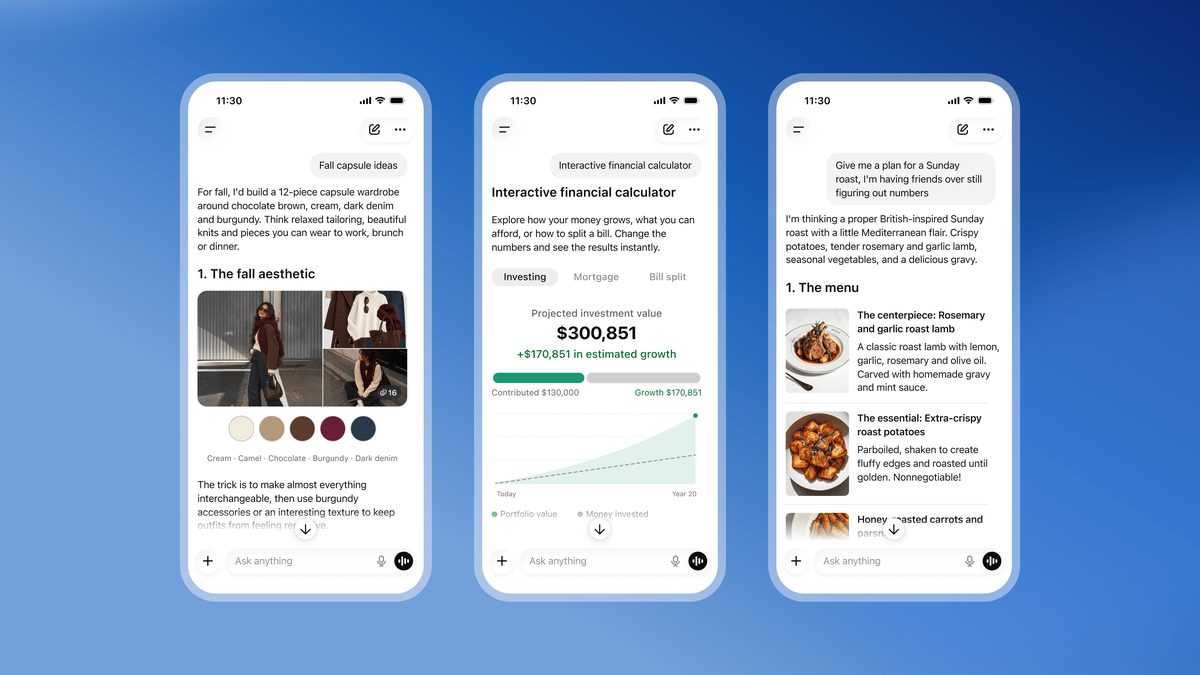
OpenAI has unveiled a significant enhancement for its popular AI chatbot, ChatGPT, introducing an 'Intelligent UI' feature that promises to revolutionize how users interact with and receive information. This update moves beyond simple text-based responses, enabling ChatGPT to dynamically generate and integrate a variety of interactive visual elements, such as charts, diagrams, and tappable buttons, directly within its answers. The rollout is happening in conjunction with the broader deployment of GPT-6, signaling a new era of more dynamic and informative AI communication.
Key Details
- Interactive Visuals: ChatGPT can now generate diagrams, charts, forms, and interactive buttons as part of its responses.
- GPT-6 Integration: The feature is powered by the latest GPT-6 model, which has been trained to decide when and how to use visuals effectively.
- Enhanced User Experience: The goal is to provide clearer, more comprehensive, and engaging answers by combining text with relevant visuals.
- Example: An illustration from OpenAI shows ChatGPT explaining bicycle design with a visual diagram and interactive elements to highlight specific parts.
Background
The evolution of AI chatbots has largely been characterized by improvements in natural language understanding and generation. While early models excelled at producing human-like text, the need for more intuitive and effective ways to convey complex information has become increasingly apparent. Traditional text-based interfaces can sometimes struggle to represent data, processes, or complex structures clearly. OpenAI's development of the 'Intelligent UI' addresses this limitation by leveraging the power of visual communication, a modality that humans naturally process with great efficiency. The training of GPT-6 specifically for this purpose indicates a strategic shift towards multimodal AI capabilities, where different forms of data—text, images, and interactive elements—are seamlessly integrated.
Impact Analysis
The introduction of interactive visuals is poised to significantly enhance the utility and user experience of ChatGPT. For educational purposes, complex topics like scientific concepts or historical timelines can be illustrated with dynamic charts and diagrams, making them easier to grasp. In problem-solving scenarios, users might receive interactive flowcharts or step-by-step visual guides. For instance, asking about a complex mechanical design could yield an interactive 3D model or a detailed schematic with clickable components, as hinted by the bicycle design example. This move towards a more visual and interactive output could dramatically reduce the cognitive load on users, making information more accessible and actionable. It also positions ChatGPT as a more versatile tool, capable of assisting with tasks that previously required specialized software or visual aids.
Broader Context
This development aligns with the broader trend in artificial intelligence towards multimodal systems that can process and generate information across different formats. Companies like Google and Meta have also been investing heavily in AI that can understand and generate images, video, and audio. OpenAI's 'Intelligent UI' represents a crucial step in making these multimodal capabilities directly accessible and useful within a conversational AI context. It suggests a future where AI assistants are not just text generators but comprehensive information providers, capable of tailoring their output to the most effective communication medium. The integration of interactive elements also hints at potential future applications in areas like user interface design, data visualization tools, and even interactive learning platforms.
Future Outlook
The 'Intelligent UI' feature is likely just the beginning of a more visually rich and interactive future for ChatGPT and similar AI models. Future iterations could see even more sophisticated visual integrations, such as live data feeds embedded in charts, interactive simulations, or even personalized visual explanations generated on the fly. The ability for AI to generate not just static images but dynamic, interactive content opens up a vast landscape of possibilities for how we learn, work, and interact with technology. As AI models become more adept at understanding user intent and context, the visual elements they generate will likely become even more personalized and relevant, further blurring the lines between digital assistants and intelligent collaborators.
Conclusion
OpenAI's 'Intelligent UI' update for ChatGPT marks a pivotal moment in the evolution of conversational AI. By enabling the chatbot to generate interactive visuals alongside text, the company is enhancing clarity, engagement, and the overall utility of its platform. Powered by the advanced GPT-6 model, this feature promises to make complex information more digestible and actionable, positioning ChatGPT as a more powerful and versatile tool for a wide range of users. As AI continues its rapid advancement, this move towards multimodal and interactive communication underscores a future where digital assistants offer richer, more dynamic, and visually compelling experiences.
Source: theverge.com