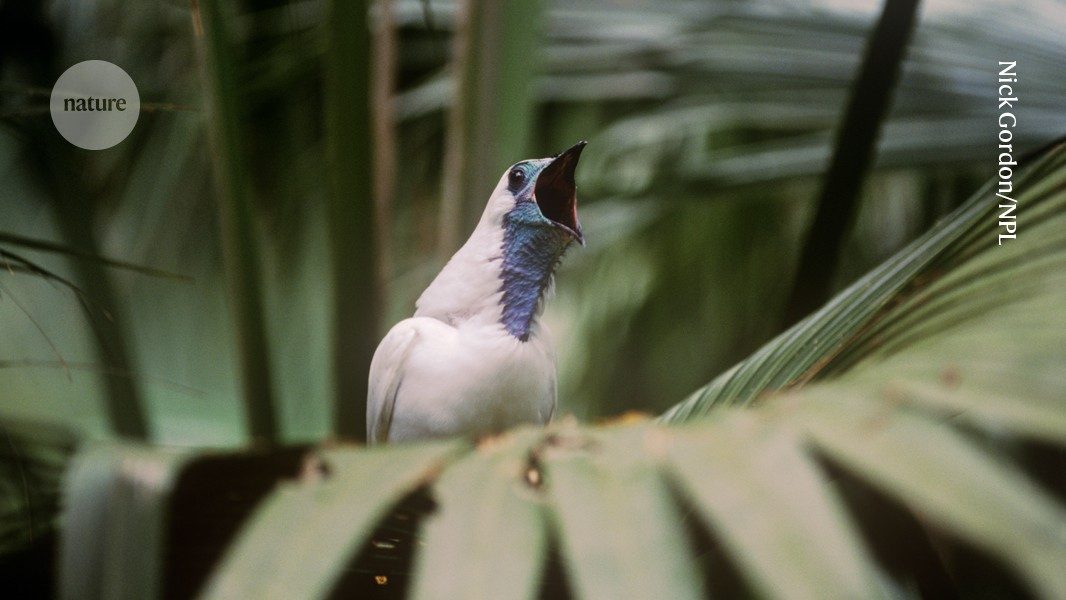
Bare-Throated Bellbird Shatters Sound Barrier: Loudest Bird Song Ever Recorded
Introduction
The quest to identify the loudest creature in the animal kingdom has taken a fascinating turn with the discovery of the bare-throated bellbird’s astonishing vocal prowess. Researchers have documented a song so powerful it rivals the noise levels of a loud concert or even a gunshot, setting a new benchmark for avian vocalizations. This finding not only highlights the extreme adaptations that can arise in species but also prompts a re-evaluation of how sound is used and perceived in the natural world.
Key Details
- Species: Bare-throated bellbird (Procnias nudicollis)
- Maximum Sound Level: Recorded at over 100 decibels (dB), with potential peaks reaching up to 125 dB.
- Comparison: This sound level is comparable to a chainsaw, a rock concert, or even a shotgun blast at close range.
- Study Publication: The findings were published in the journal Evolution.
- Researchers: The research was led by Jeff C. T. Menezes and Joep Podos.
- Mechanism: The extreme volume is achieved through a unique syrinx structure and forceful exhalation, allowing the bird to project its call over long distances.
Background
For decades, scientists have been intrigued by the diverse and often surprisingly loud calls of birds. Species like the screaming piha and the kakapo have previously held records for their vocal intensity. However, the bare-throated bellbird, a resident of the Atlantic Forest in Brazil, has now surpassed all known contenders. The study, spearheaded by Jeff C. T. Menezes and Joep Podos, focused on understanding the physical mechanisms behind the bellbird’s song. They observed that the males, during their mating displays, produce a call that is not only incredibly loud but also characterized by a distinctive, resonant tone.
Impact Analysis
The implications of such a powerful vocalization are profound. Primarily, it suggests that the evolutionary pressures for attracting mates or defending territory can drive species to produce sounds at the physical limits of what is biologically possible. The sheer volume of the bellbird’s song likely serves to cut through the dense forest canopy, ensuring its call reaches potential mates or rivals across significant distances. However, this extreme loudness also raises questions about the potential impact on the bird’s own hearing and the hearing of other animals in its environment. It’s possible that the bellbird has evolved specialized adaptations to protect its auditory system from its own deafening calls.
Broader Context
This discovery fits into a larger scientific narrative about the evolution of communication signals. Sound is a crucial medium for communication in many species, and its effectiveness is often a balance between loudness, clarity, and energetic cost. The bare-throated bellbird’s song represents an extreme strategy, prioritizing sheer volume. This contrasts with other species that might rely on more complex songs or subtle cues. Understanding these diverse strategies helps us appreciate the multifaceted ways in which life has adapted to communicate in various ecological niches.
Future Outlook
Further research is warranted to fully understand the physiological adaptations that allow the bare-throated bellbird to produce and withstand such intense sound. Investigations into its syrinx structure, respiratory system, and potential auditory protection mechanisms could reveal novel biological insights. Additionally, studying the behavioral ecology of the bellbird will be crucial to understanding how this extreme vocalization influences mating success, social interactions, and predator avoidance. The study also opens avenues for exploring sound pollution in natural habitats and its potential effects on species with sensitive auditory systems.
Conclusion
The bare-throated bellbird has claimed the title of the world’s loudest bird, with a song that pushes the boundaries of acoustic biology. This remarkable finding, detailed in the journal Evolution, underscores the power of natural selection to shape extraordinary adaptations. As scientists continue to unravel the mysteries of this vocal titan, we gain a deeper appreciation for the complex and often surprising ways in which animals communicate and thrive in their environments.
Source: nature.com