Robots Achieve Solidly Amateur Performance in Infinite Table Tennis Match
Introduction
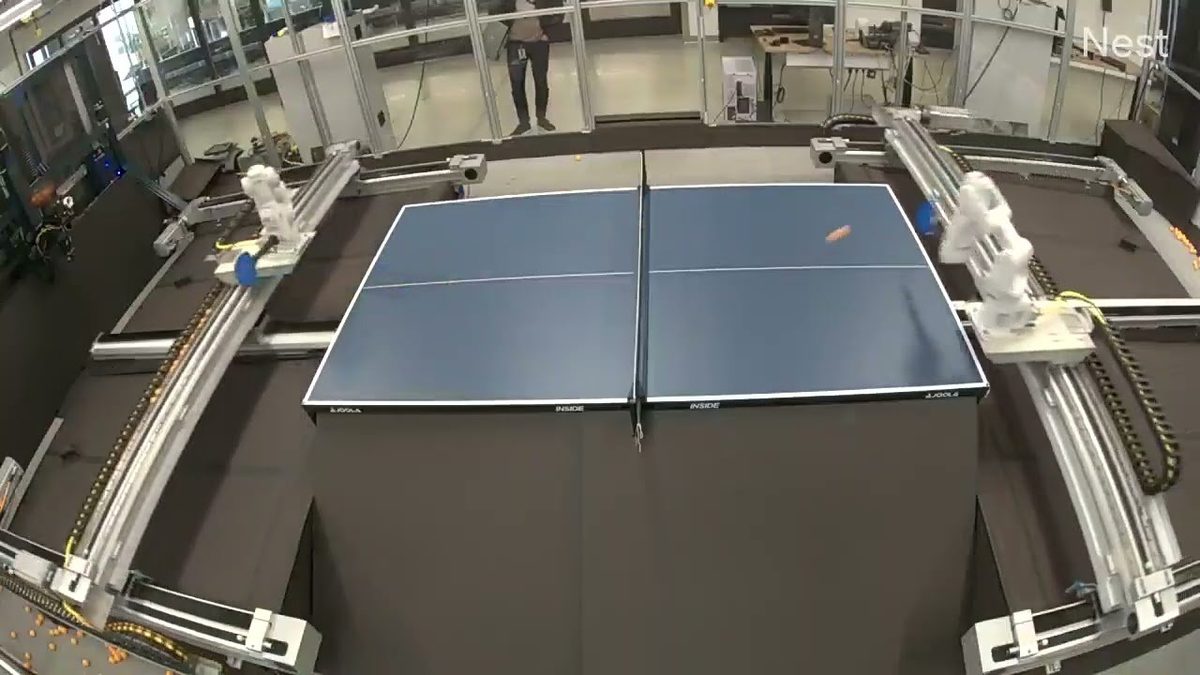
In a research lab just south of Wimbledon, a different kind of historic match is unfolding—one without a final score, no spectators, and no end in sight. Google DeepMind has deployed two robotic arms in a perpetual game of table tennis, a project not aimed at entertainment but at advancing the frontier of artificial intelligence. Unlike the legendary 11-hour 2010 Wimbledon marathon between John Isner and Nicolas Mahut, this contest has no finish line. Instead, the goal is continuous improvement through self-play and human interaction. The robots, trained using reinforcement learning and augmented with AI coaching, have now reached what researchers describe as 'solidly amateur human performance'—a milestone that signals meaningful progress in the quest for general-purpose robotics.
Key Details
- Google DeepMind launched the table tennis robot project in 2022 to explore scalable methods for training adaptable AI agents.
- The robots use reinforcement learning and have been refined through matches against humans of varying skill levels.
- They achieved a 45% win rate across 29 human games, including a 55% success rate against intermediate players.
- The system now integrates Google Gemini’s vision-language model as an AI 'coach' to provide real-time feedback.
- The robots are not yet competitive against advanced human players but outperform beginners and match intermediates.
- Findings were detailed in a 2024 research paper available on arXiv (arXiv:2408.03906) and discussed in an IEEE Spectrum blog by DeepMind engineer Pannag Sanketi and ASU professor Heni Ben Amor.
Background
For decades, robotics researchers have faced a fundamental challenge: how to teach machines to operate in unpredictable, real-world environments. While robots like Boston Dynamics’ Atlas can perform scripted acrobatics, such feats rely heavily on manual programming and fail in dynamic settings. The need for robots that learn autonomously has grown alongside interest in humanoid assistants for homes, factories, and care facilities. Table tennis, with its rapid pace, spin dynamics, and strategic depth, emerged as an ideal testbed. As early as the 1980s, roboticists used the sport to evaluate motor control and perception. DeepMind’s approach, however, shifts from isolated skill acquisition to continuous, competitive learning—a paradigm inspired by how humans evolve through repeated play.
Impact Analysis
The significance of DeepMind’s table tennis robots lies not in their current skill level but in their learning trajectory. By pitting robotic agents against each other and against humans, researchers simulate a dynamic environment where adaptation is essential.
“We are optimistic that continued research in this direction will lead to more capable, adaptable machines that can learn the diverse skills needed to operate effectively and safely in our unstructured world,”wrote Sanketi and Ben Amor in IEEE Spectrum. The robots’ ability to sustain rallies and adjust tactics—such as mixing defensive lobs with aggressive smashes—demonstrates a level of decision-making beyond pre-programmed responses. Moreover, the integration of Google Gemini as a coaching AI introduces a novel feedback loop: the system analyzes video footage to suggest strategic improvements, like hitting 'shallow balls close to the net' or targeting specific zones. This mimics how human athletes use video review, but at machine speed and scale.
Broader Context
The project fits into a larger push for general-purpose AI in robotics, often described as the 'ChatGPT moment' for machines. Just as large language models revolutionized text generation by learning from vast datasets, researchers hope that AI trained through diverse physical interactions can unlock similarly transformative capabilities in robotics. This ambition confronts Moravec’s paradox—the counterintuitive reality that tasks easy for humans, like catching a ball or folding laundry, are extremely difficult for robots. DeepMind’s prior work, such as teaching a robot to tie shoelaces, and Boston Dynamics’ real-time error correction in industrial tasks, suggests progress is accelerating. Yet, true autonomy remains distant. The table tennis robots, while impressive, still lack the dexterity and contextual awareness of even a novice human player. Their environment is controlled, and their responses are constrained by training data.
Future Outlook
Looking ahead, the implications of infinite self-play extend beyond sports. If robots can refine skills indefinitely through competition, the same framework could train them for complex real-world tasks—navigating cluttered homes, assisting in surgeries, or managing warehouse logistics. Scaling this approach will require more robust hardware, improved sensor fusion, and AI models capable of transferring knowledge across domains. DeepMind’s use of vision-language models like Gemini hints at a hybrid future where robots learn not only from physical interaction but also from textual instructions and observational data. Funding and long-term commitment from Google suggest this research will continue to evolve, potentially feeding into broader Alphabet initiatives in AI and robotics.
Conclusion
While the robotic arms may never win a championship, their never-ending rallies represent a quiet revolution in how machines learn. By embracing unpredictability, competition, and continuous feedback, DeepMind is building the foundation for robots that don’t just perform tasks—but adapt, improve, and eventually, collaborate. The infinite game of table tennis is not about winning. It’s about becoming better, one swing at a time.