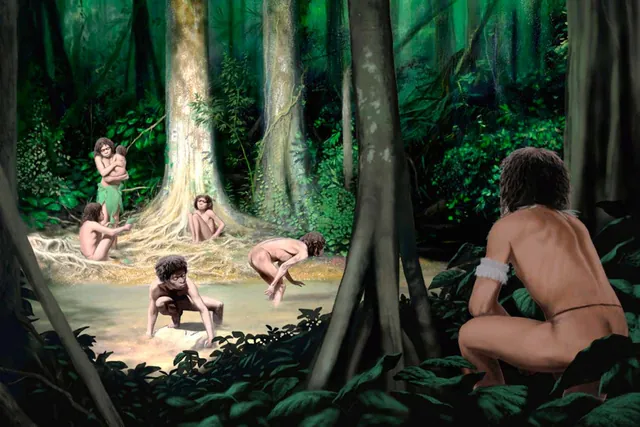
Reevaluating Humanity: The Implications of Homo naledi's Burial Practices

Reevaluating Humanity: The Implications of Homo naledi's Burial Practices
Introduction
The discovery of burial practices among the species Homo naledi has sparked a profound debate within the fields of archaeology and anthropology. This ancient hominin, which lived approximately 335,000 to 236,000 years ago in South Africa, has exhibited behaviors that were once thought to be exclusive to modern humans. If these findings are confirmed, they could significantly shift our understanding of what it means to be human.
Key Details
- Homo naledi, a species with a brain size roughly one-third that of modern humans, has shown evidence of deliberate burial practices.
- The archaeological site, known as the Rising Star Cave system, has yielded numerous remains, suggesting a complex social structure.
- This discovery challenges the notion that advanced cognitive abilities were a prerequisite for burial rites.
- The implications of these findings extend to our understanding of emotional bonds, social behaviors, and the cultural practices of early hominins.
- Scholars are now reexamining the timeline of human evolution in light of these practices.
Background
Homo naledi was discovered in 2013, and subsequent excavations have revealed a trove of fossils that have puzzled researchers. With a unique combination of primitive and modern traits, this species raises questions about the evolutionary lineage of humans. The recent focus on its burial practices adds another layer to this ongoing research. Traditionally, burial practices have been associated with Homo sapiens and Neanderthals, indicating a level of cognitive sophistication and social complexity.
Analysis
If ancient humans with brains significantly smaller than our own could perform what we consider complex rituals, then the criteria we use to define humanity may need to be reexamined. The ability to bury the dead implies not only an understanding of mortality but also a degree of emotional attachment to individuals within a community. This suggests that Homo naledi may have possessed a form of social and emotional intelligence previously attributed solely to modern humans.
Moreover, these findings could indicate that cultural practices, such as burial, may have developed much earlier in human evolution than previously thought. It challenges the long-held view that sophistication in social behavior is unique to Homo sapiens. The evidence of burial practices among Homo naledi could mean that many hominin species exhibited similar behaviors, which could lead to a reevaluation of the timeline of human evolution.
As researchers delve deeper into the implications of these findings, it prompts a broader discussion about the nature of humanity itself. Are we truly unique in our ability to create complex social structures and cultural practices? Or are we part of a continuum of behaviors that have been present in various forms throughout human history?
Conclusion
The implications of Homo naledi's burial practices are vast, potentially redefining our understanding of human evolution and what it means to be human. As further studies are conducted, the archaeological community will continue to explore the social behaviors of ancient hominins. This discovery not only enriches our understanding of Homo naledi but also invites us to reconsider the qualities that distinguish humans from other species. In a world where the definition of humanity is constantly evolving, these findings remind us that our lineage is deeper and more complex than we may have realized.