Parasitic Fly Ormia ochracea Gives Live Birth Inside Crickets, Unveiling 10-14 Day Host Kill Cycle
Introduction
While live birth is commonly associated with mammals, recent research has highlighted that certain insect species also exhibit this reproductive mode. The parasitic fly Ormia ochracea (O. ochracea), known for its remarkable auditory system that allows precise localization of cricket hosts, has now been shown to give live birth inside crickets. This discovery provides new insights into insect reproductive biology, parasitic strategies, and host interactions.
Key Details
- The study, published in the Annals of the Entomological Society of America, documents how female O. ochracea develop embryos in a uterus-like structure, nourishing them internally until they hatch as fully-formed larvae.
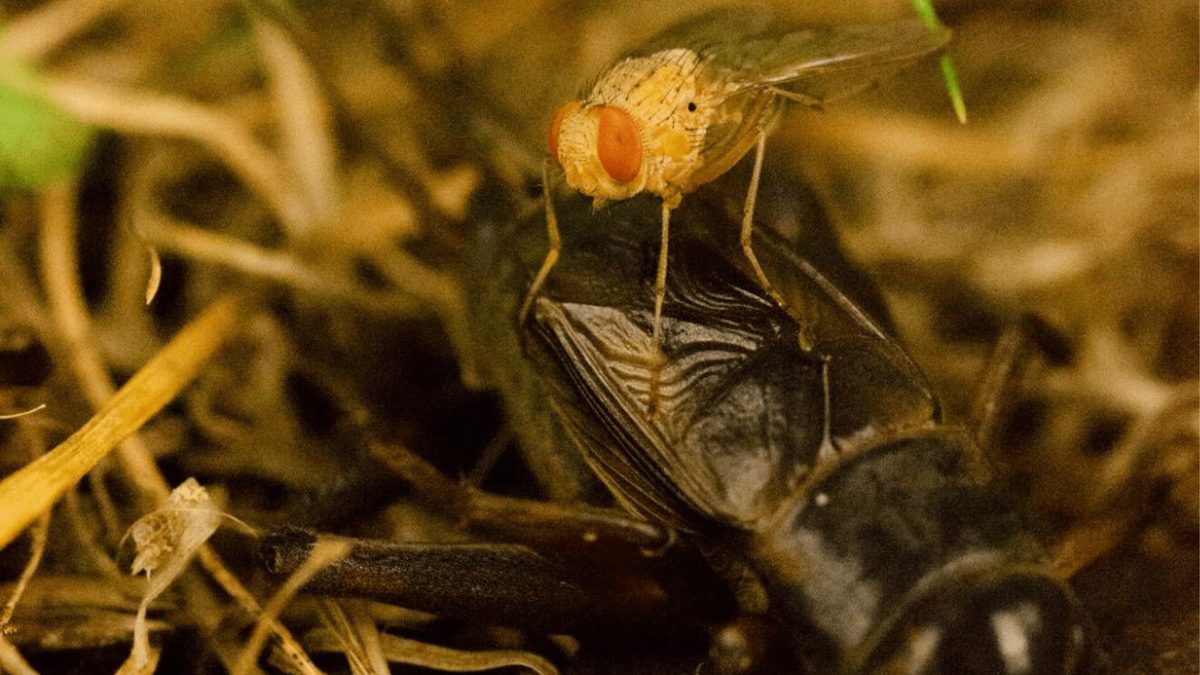
- Larvae are deposited directly onto cricket hosts, burrow inside, and complete their development over 10 to 14 days, ultimately killing the host.
- The reproductive mode is identified as adenotrophic viviparity, where embryos receive maternal nourishment internally.
- Some capacity for partial parthenogenesis is observed, with unfertilized eggs undergoing early embryonic development but not reaching full larval stages.
- Research methods included dissection, fluorescence staining, and microscopy to visualize embryonic development.
- The study was co-authored by neuroscientists and biologists from St. Olaf College, with undergraduate Parker Henderson playing a key research role.
Background
Live birth, or viviparity, is traditionally associated with mammals but is also found in various other taxa such as sharks (porbeagles, hammerheads, makos, great whites), certain frogs, and a few lizard species (e.g., Lerista bougainvillii, Zootoca vivipara, and Saiphos equalis). In insects, however, this reproductive mode is rare and poorly understood.
O. ochracea is a parasitoid fly that locates male crickets by eavesdropping on their mating calls, leveraging its highly directional auditory system. Once a host is located, the female fly deposits larvae that parasitize the cricket internally.
Impact Analysis
The discovery of adenotrophic viviparity in O. ochracea expands our understanding of insect reproductive diversity. Nourishing embryos internally before live birth is a complex adaptation that likely offers survival advantages to the emerging larvae, optimizing host colonization.
The fly’s life cycle, culminating in host death within 10 to 14 days, illustrates a finely tuned parasitic relationship that impacts insect population dynamics and potentially broader ecosystem processes. This biological interaction offers a natural model to study host-parasite coevolution, developmental biology, and reproductive adaptations.
Furthermore, the capacity for partial parthenogenesis introduces intriguing questions about the genetic and developmental flexibility of this species.
Broader Context
Understanding parasitic life cycles is crucial for applied sciences, including agriculture and pest management. Flies like O. ochracea can influence cricket populations, some of which are agricultural pests, suggesting potential biological control applications.
Additionally, O. ochracea's exquisitely sensitive directional hearing has already inspired technological innovations such as improved hearing aids and acoustic sensors, highlighting the intersection between biological research and bio-inspired engineering.
From an educational perspective, the involvement of undergraduate students like Parker Henderson underscores the importance of hands-on research in cultivating the next generation of scientists and enhancing public scientific literacy.
Future Outlook
This study lays the foundation for genetic and developmental research in Ormia, though internal embryonic development presents technical challenges for genetic manipulation. Targeting sperm instead of eggs may be necessary for future investigations.
Further research into resource competition among larvae and the genetic mechanisms behind adenotrophic viviparity and partial parthenogenesis could deepen understanding of evolutionary adaptations and reproductive strategies.
Continued investment in undergraduate research is essential to drive discoveries and nurture scientific talent, as emphasized by the study's co-authors.
Conclusion
The revelation that the parasitic fly Ormia ochracea gives live birth inside cricket hosts, supporting embryonic development through adenotrophic viviparity, enriches our comprehension of insect biology, parasitism, and reproductive evolution. This work not only sheds light on a fascinating ecological interaction but also holds implications for pest control, bio-inspired technologies, and science education.
“The complexity of their reproductive strategy raises fascinating questions about insect development and host-parasite evolution.” – Eric Cole, St. Olaf College biologist and study co-author
As research progresses, the unique biology of O. ochracea promises to illuminate broader biological principles and inspire innovative applications.