New Robot Digitizes Rare Books at 2,500 Pages Per Hour Without Damage
Introduction
For decades, libraries and preservationists have grappled with a delicate balancing act: how to digitize rare and fragile books without causing them harm. These invaluable manuscripts, often one-of-a-kind or out of copyright, require careful handling to maintain their physical integrity. While digitization opens doors for greater access and scholarly research, traditional methods have been painstakingly slow and risky.
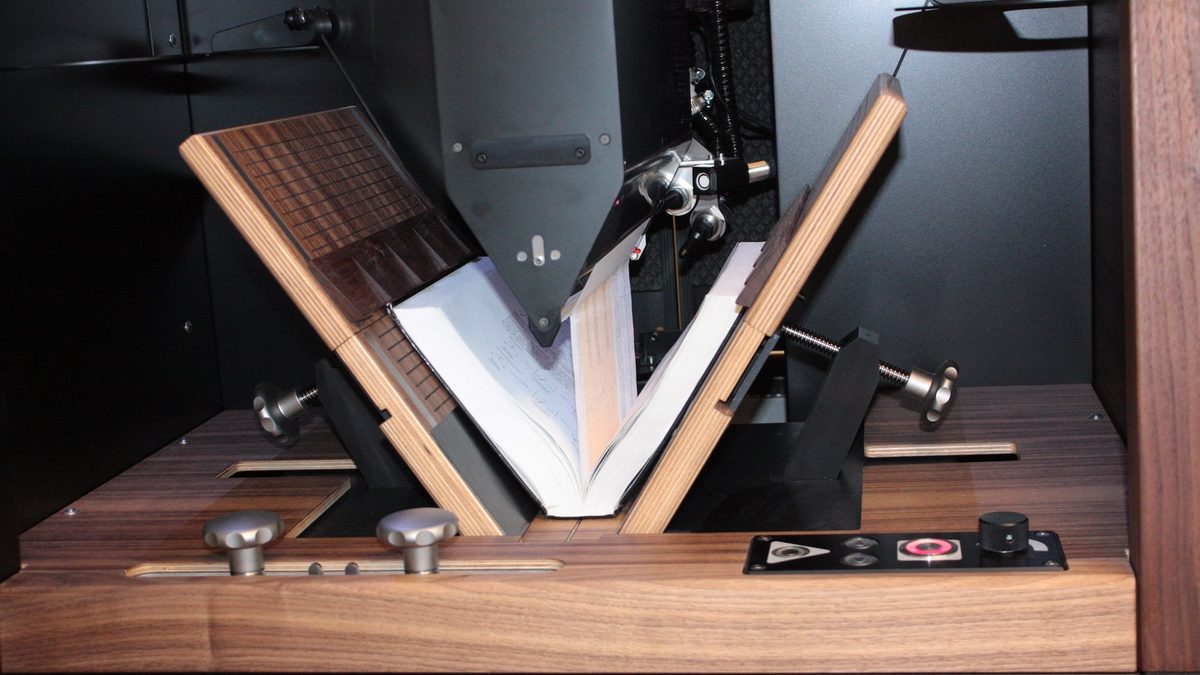
Recently, the University of Tulsa’s McFarlin Library introduced a revolutionary technological solution: the Treventus ScanRobot 2.0, a robot capable of autonomously scanning rare books at an astonishing speed of up to 2,500 pages per hour. This innovation promises to transform the archival digitization landscape by combining efficiency with preservation.
Key Details
- The Treventus ScanRobot 2.0 is designed and manufactured in Austria.
- It scans two pages simultaneously using a camera positioned in the book’s gutter (the central margin).
- Utilizes a vacuum system to gently pull pages for scanning without direct contact.
- Air nozzles softly turn pages between scans.
- Requires certified operators to monitor and control the scanning process in real time.
- The system can scan up to 2,500 pages per hour, dramatically reducing manual labor.
- Approximately 64,000 books at McFarlin Library are out of copyright and eligible for digitization.
Background
Preserving rare books has always been a priority for libraries and archives. Traditional digitization techniques typically involved placing a book in a cradle and photographing each page individually—a slow and labor-intensive process. Later, document camera arrays improved the workflow by capturing pages from above but still required manual page turning and close handling.
The challenge has always been to digitize without inflicting physical stress on fragile pages. Frequent handling can accelerate deterioration, causing tears, discoloration, or loss of binding integrity. Hence, the need for a technology that could scan quickly, gently, and reliably.
Enter the Treventus ScanRobot 2.0. After two years of research, University of Tulsa archivists chose this robot for its innovative approach. By automating page turning and minimizing contact through vacuum suction and air puffs, the system protects books from potential damage while vastly increasing throughput.
Impact Analysis
The introduction of such robotic technology has several profound implications:
- Preservation: Reduced manual handling decreases wear and tear on delicate collections, extending their lifespan.
- Accessibility: Digitized books can be made available online, enhancing access for students, scholars, and the public worldwide.
- Efficiency: The ScanRobot 2.0’s speed—2,500 pages per hour—significantly cuts down time and labor costs associated with digitization.
- Training and Oversight: Despite automation, human oversight remains essential; certified operators monitor the process to manage any issues immediately.
- Scalability: With tens of thousands of out-of-copyright books awaiting digitization, institutions can accelerate their digital archives expansion.
“Our assessments show that around 64,000 of our books are out of copyright and could be scanned and uploaded, and more books join the public domain every year,” explained the library’s rare books cataloger Kunz. “There will always be books to make available for our students and scholars.”
Broader Context
The deployment of the ScanRobot 2.0 fits into a broader global effort to digitize cultural heritage materials. Institutions worldwide are racing to convert physical archives into digital formats to preserve knowledge against physical degradation, disasters, or loss. However, digitization often requires balancing speed, cost, and preservation standards.
Advanced robotic scanning technologies are emerging as key tools because they reduce human error and physical strain on materials. Such innovations are particularly crucial for fragile items like medieval manuscripts, first editions, and rare collections that cannot be easily replaced.
Moreover, digitization fosters democratization of information by providing broader access to historically significant texts, many of which were previously accessible only to a limited audience. This aligns with academic and public interests in making knowledge more widely available.
Future Outlook
Looking ahead, the success of the ScanRobot 2.0 may encourage other libraries and archives to adopt similar technologies, accelerating the pace of digitization projects worldwide. Continuous improvements in robotics, imaging quality, and AI-assisted page recognition could further enhance both speed and accuracy.
Additionally, as copyright laws evolve and more works enter the public domain, demand for digital copies will only grow. Institutions will need to balance ethical considerations such as intellectual property rights with the imperative to preserve and share cultural heritage.
Investment in operator training will remain critical to ensure human oversight complements automation, preventing errors, and safeguarding rare collections.
Conclusion
The Treventus ScanRobot 2.0 represents a significant breakthrough in the digitization of rare books, providing a solution that combines high-speed scanning with careful preservation. Its deployment at the University of Tulsa’s McFarlin Library marks a crucial step toward expanding digital access to rare texts while safeguarding their physical condition.
By embracing such innovative technologies, libraries can better serve researchers, students, and the public, ensuring that treasured manuscripts survive for future generations both physically and digitally.