Brain-Immune Signaling Breakdown Linked to Neurodegeneration
Introduction
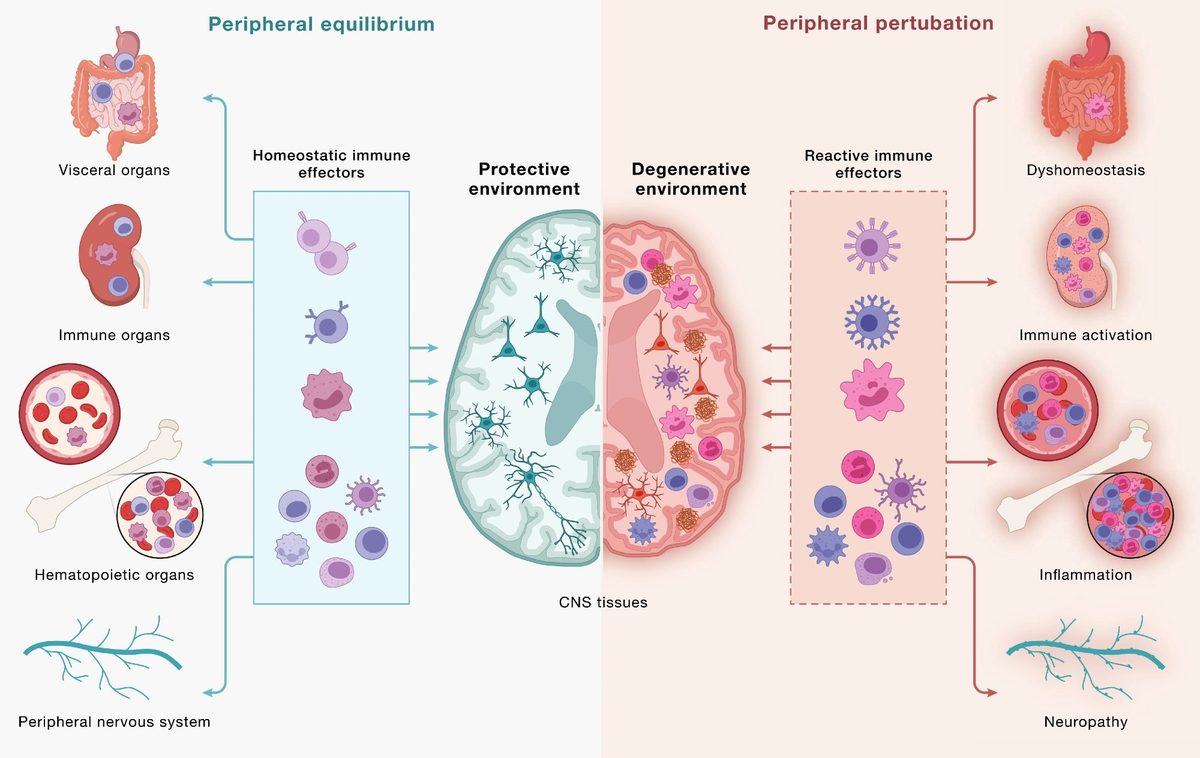
Neurodegenerative diseases, long thought to primarily stem from neuronal dysfunction, are increasingly being understood as complex conditions involving intricate interactions between the brain and the immune system. A recent perspective published in the prestigious journal Cell synthesizes a growing body of evidence, proposing that dysregulated neuroimmune crosstalk is not merely a symptom but a significant contributing factor to the onset and progression of these debilitating disorders. This viewpoint reframes immune dysfunction as a "concause" of neurodegeneration, highlighting its potential to interact with and exacerbate neuronal vulnerabilities.
Key Details
- Bidirectional Communication: The brain and peripheral immune system engage in a continuous, two-way dialogue. Immune cells from the body regularly interact with central nervous system (CNS) tissues, and in turn, are shaped by signals originating from the brain.
- Protective vs. Pathogenic Roles: This same intricate circuitry can yield protective outcomes, supporting neural health, plasticity, and repair under normal conditions. However, age-associated immune dysfunction can reshape this circuit, leading to altered immune cells entering the CNS and promoting a degenerative environment.
- Three Frameworks of Interaction: The research synthesizes evidence into three key frameworks: "outside-in" effects driven by peripheral immunity, "inside-out" signaling orchestrated by brain-resident microglia, and "locked-in" gene regulatory programs that can perpetuate maladaptive neuroimmune states.
- Gut-Brain Axis Influence: The gut microbiome plays a crucial role, with T cells educated in gut-associated immune tissues capable of trafficking to the CNS. Changes in gut microbiota can influence immune activity and microglial function, underscoring the importance of the gut-brain axis.
- Cellular Players: Key immune cells involved include T cells, B cells, monocytes, NK cells, dendritic cells, mast cells, neutrophils, and innate lymphoid cells. Microglia, the brain's resident immune cells, are central to integrating signals and can adopt disease-associated programs when dysregulated.
Background
Traditionally, immune dysregulation was viewed as a consequence of neurodegenerative diseases. However, recent scientific advancements are challenging this paradigm. Researchers now posit that disordered communication between the brain and the immune system can actively contribute to disease initiation and advancement. Understanding this complex interplay is crucial for developing effective therapeutic strategies, particularly those that target immune modulation.
Impact Analysis
The implications of this research are profound. By identifying neuroimmune crosstalk as a potential driver, new therapeutic avenues can be explored. Strategies aimed at restoring immune homeostasis or recalibrating neuroimmune signaling could offer novel approaches to slow disease progression and potentially promote recovery. This shifts the focus from solely targeting neuronal pathology to also addressing the immune system's role in maintaining brain health.
Broader Context
The brain is not an isolated organ; it is deeply integrated with the body's immune system. Structures like the choroid plexus, meninges, and vascular networks act as interfaces, relaying signals between the CNS and peripheral immune cells. This constant communication is vital for neural integrity but can become detrimental when dysregulated. The gut-brain axis, mediated by nerves like the vagus and immune cell trafficking, further highlights this interconnectedness. Conditions like T cell activity being implicated in Parkinson's disease (PD), Alzheimer's disease (AD), and Amyotrophic Lateral Sclerosis (ALS) underscore the widespread impact of immune involvement.
Future Outlook
Future research must focus on elucidating the precise timing, specificity, and directionality of these neuroimmune signals in humans. Longitudinal studies are essential to establish causal relationships rather than mere correlations. Clarifying these dynamics will be critical for designing targeted immunotherapies. The authors emphasize that while current treatments often focus on pathological hallmarks or microglia, modulating broader immune circuits that influence synapse loss and neuronal death may yield greater therapeutic benefits.
Conclusion
The perspective presented in Cell strongly supports the hypothesis that disrupted brain-immune communication is a key contributor to neurodegeneration. Recognizing the immune system not just as a bystander but as an active participant in disease pathogenesis opens up exciting possibilities for intervention. By understanding and modulating the complex neuroimmune network, scientists hope to develop more effective treatments for a range of neurodegenerative conditions.
Journal Reference: Bennett, F. C., Hong, S., Jiang, N., & Marazzi, I. (2026). Neurodegeneration as a dysregulation of neuroimmune crosstalk. Cell, 189, 5156-5173. DOI: 10.1016/j.cell.2026.07.015
Source: news-medical.net