Betelgeuse’s Hidden Companion Revealed: 6-Year Brightness Mystery Solved
Introduction
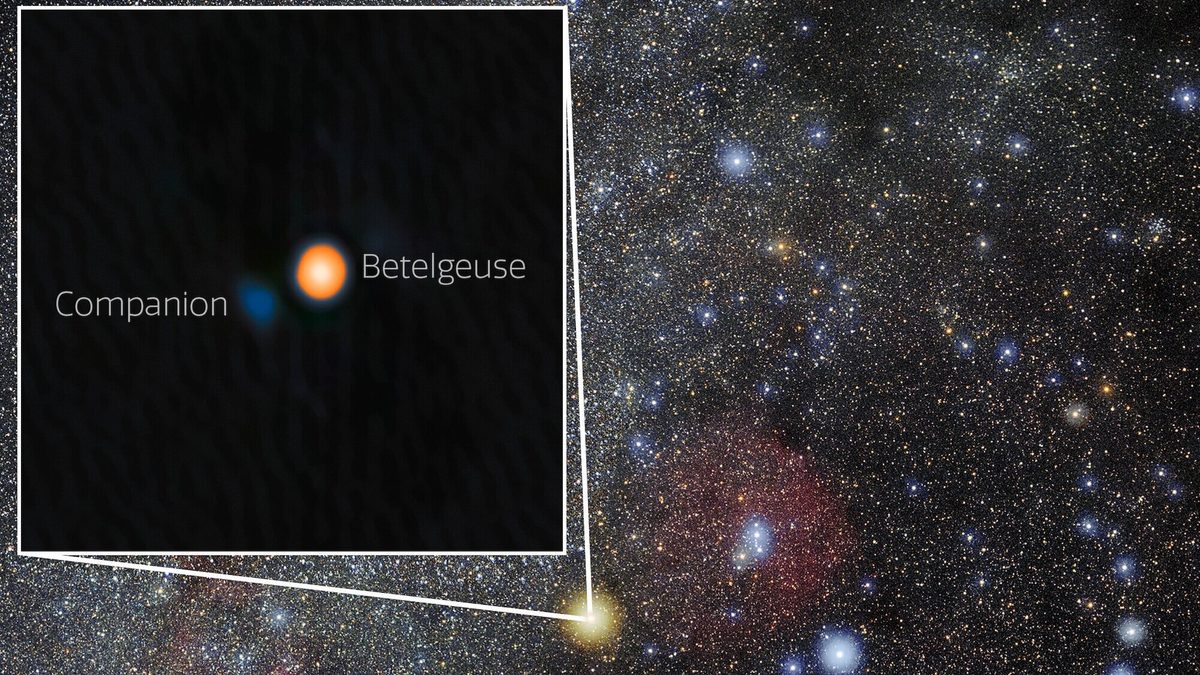
One of the most prominent stars in the night sky has finally revealed one of its deepest secrets. Betelgeuse, the red supergiant anchoring the shoulder of the Orion constellation, has long fascinated astronomers and skywatchers alike. Known for its variable brightness and potential to end its life in a spectacular supernova, Betelgeuse has been under intense scrutiny for centuries. Now, after years of debate and failed detection attempts, a faint companion star has been directly observed orbiting Betelgeuse — a discovery that resolves a fundamental question about the star’s mysterious six-year variability cycle.
Key Details
- The companion star was detected using the 'Alopeke speckle imager on the Gemini North telescope in Hawai’i.
- It is approximately six magnitudes fainter than Betelgeuse and has a mass about 1.5 times that of the Sun.
- The star is likely an A- or B-type pre-main-sequence star — young, hot, and not yet fusing hydrogen in its core.
- The orbital period responsible for the 6-year brightness variation has been attributed to gravitational and tidal interactions with this newly found companion.
- Two studies detailing the discovery are set to be published on July 24 in The Astrophysical Journal Letters.
Background
Betelgeuse, located about 550 light-years from Earth, has long been known for its semi-regular variability in brightness. It exhibits two distinct cycles: a primary pulsation period of roughly 400 days and a longer, secondary cycle of about 6 years. While the 400-day variation is attributed to internal stellar pulsations — a common trait among red supergiants — the origin of the 6-year cycle remained elusive. Several theories were proposed, including internal convective processes and magnetic activity. However, a growing body of research over the past decade suggested that an external influence, such as a binary companion, could be responsible.
Despite efforts using powerful observatories like the Hubble Space Telescope and the Chandra X-Ray Observatory, no companion had been directly imaged. The extreme brightness of Betelgeuse and the expected faintness of any companion made detection nearly impossible with conventional imaging techniques. Many astronomers, including co-author Steve Howell of NASA’s Ames Research Center, believed the companion might remain forever hidden.
"Papers that predicted Betelgeuse's companion believed that no one would likely ever be able to image it,"Howell stated, underscoring the technical challenges involved.
Impact Analysis
The breakthrough came with the use of 'Alopeke — a high-resolution speckle imaging instrument whose name means "fox" in Hawaiian. Mounted on the 8.1-meter Gemini North telescope atop Mauna Kea, 'Alopeke captures thousands of rapid, short-exposure images to counteract atmospheric distortion. This technique, known as speckle interferometry, allows astronomers to resolve extremely close and faint objects near bright stars.
Using this method, researchers were able to detect a faint point of light orbiting Betelgeuse at a distance comparable to the orbit of Neptune in our solar system. Further spectroscopic and photometric analysis confirmed the object’s stellar nature and estimated its mass at 1.5 solar masses. Its classification as an A- or B-type pre-main-sequence star suggests it formed around the same time as Betelgeuse but has not yet reached the main sequence phase of its evolution.
The discovery provides a compelling explanation for the 6-year brightness cycle: as the companion orbits, gravitational tides distort Betelgeuse’s outer layers, modulating its luminosity. This interaction may also influence mass ejection events, such as the one responsible for the "Great Dimming" of 2019–2020, when Betelgeuse unexpectedly faded by more than 60% due to a dust cloud expelled from its surface.
Broader Context
This finding has significant implications for the study of variable stars. Red supergiants like Betelgeuse are critical for understanding stellar evolution and the chemical enrichment of galaxies through supernova explosions. The presence of a companion star suggests that binary interactions may play a more important role in shaping the behavior and ultimate fate of massive stars than previously thought.
Moreover, binary systems are now believed to influence processes such as angular momentum transfer, mass loss, and even the geometry of supernova remnants. The Betelgeuse system may serve as a nearby laboratory for studying these interactions in real time.
Future Outlook
Astronomers are eager to observe the system in greater detail when the companion reaches its farthest orbital point from Betelgeuse in November 2027. This increased separation will make high-contrast imaging easier and allow for more precise measurements of the star’s orbit, mass, and spectral properties.
Long-term, the system is expected to end dramatically. Due to tidal forces, the companion is predicted to spiral into Betelgeuse within the next 10,000 years. This merger could trigger enhanced mass loss or even influence the timing and nature of Betelgeuse’s eventual supernova — an event that, when it occurs, will be visible in broad daylight from Earth.
Conclusion
The discovery of Betelgeuse’s companion star marks a major milestone in observational astronomy. It exemplifies how technological innovation — in this case, speckle imaging — can solve long-standing astrophysical mysteries. By confirming the existence of a binary companion, researchers have not only explained the 6-year variability but also opened new pathways for understanding the complex lives of massive stars. As study co-author Howell noted, what once seemed impossible has now become a cornerstone of stellar science, reminding us that even the most familiar objects in the sky still hold secrets waiting to be uncovered.