Astronomers Capture First Signs of Planet Formation Around Baby Star 1,300 Light-Years Away
Introduction
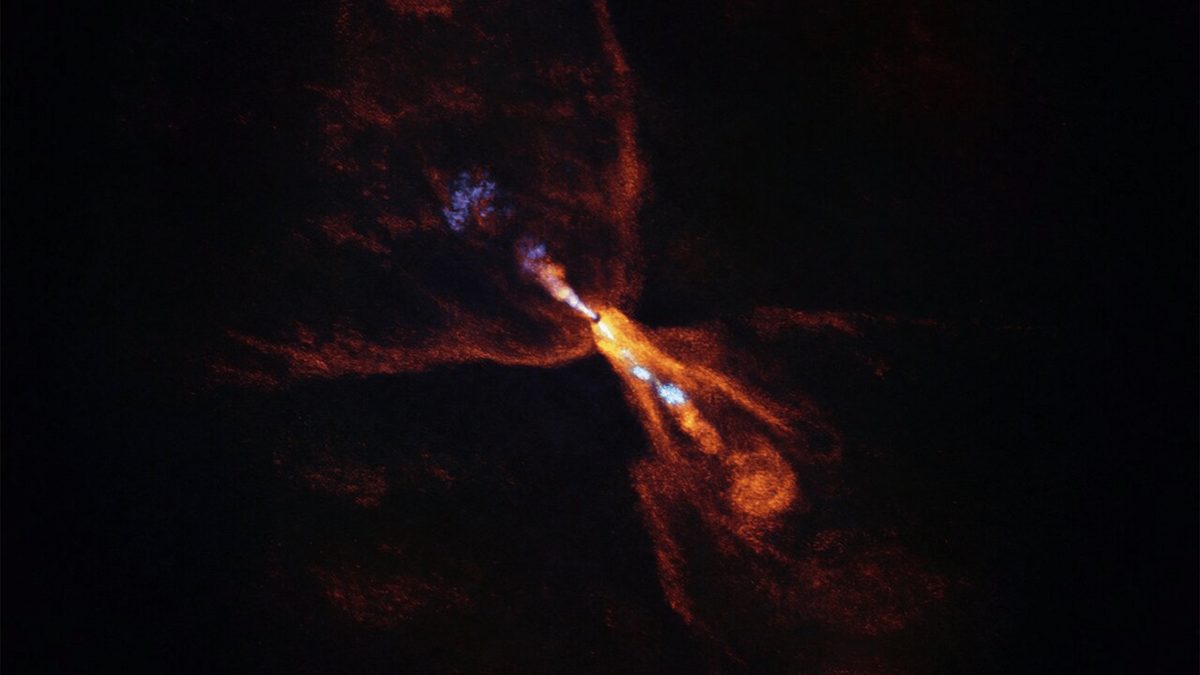
In a groundbreaking discovery, astronomers have for the first time directly observed the initial stage of planet formation around a young star outside our Solar System. This milestone, achieved through combined observations with the James Webb Space Telescope (JWST) and the Atacama Large Millimeter/submillimeter Array (ALMA) in Chile, marks a significant leap in understanding how planetary systems emerge from cosmic dust and gas.
Key Details
- The star at the center of this discovery is HOPS-315, a proto-star located approximately 1,300 light-years from Earth.
- Researchers detected hot minerals, specifically silicon monoxide molecules, beginning to condense into solid crystalline structures within the star's protoplanetary disc.
- This condensation is believed to be the earliest phase of planet formation, where microscopic dust grains start to solidify and eventually coalesce into planetesimals, the building blocks of planets.
- The research is detailed in a study published on July 16, 2025, in the journal Nature, led by an international team including Purdue University astronomer Merel van ‘t Hoff and Leiden University’s Melissa McClure.
- The study utilized the high-resolution imaging capabilities of JWST alongside ALMA’s powerful radio observations to pinpoint the region in the disc equivalent to the asteroid belt in our Solar System.
Background
Planet formation begins in protoplanetary discs—vast circumstellar accumulations of gas and dust orbiting young stars. Within these discs, dust grains collide and stick together to form larger bodies called planetesimals. These planetesimals, over millions of years, accumulate more material, eventually forming planets ranging from small terrestrial worlds to gas giants like Jupiter.
Until now, astronomers have mainly observed more evolved discs where large, already formed exoplanets are present. However, the earliest stages of planet formation, particularly the condensation of the first solid materials, remained elusive. In our own Solar System, the oldest solids—chondrules and crystalline minerals found in ancient meteorites—provide clues that planet formation commenced about 4.6 billion years ago. These solids condensed at high temperatures and are believed to have been the seeds for planetesimals.
Impact Analysis
The detection of hot minerals beginning to solidify in the protoplanetary disc around HOPS-315 offers a rare glimpse into the very first steps of planet formation. This observation confirms theoretical predictions about the timing and conditions under which solid grains start to form in stellar discs.
“For the first time, we have identified the earliest moment when planet formation is initiated around a star other than our Sun,” said Melissa McClure, co-author and astronomer at Leiden University.
Moreover, the chemical signature of silicon monoxide in both gaseous and solid states implies an active transition phase of mineral condensation. This process, never before observed outside our Solar System, emphasizes how common these planetary formation mechanisms might be across the galaxy.
Broader Context
The study's broader significance lies in its potential to act as a proxy for understanding how our own Solar System formed. The location of this mineral condensation near HOPS-315 corresponds spatially to the asteroid belt region in our Solar System, where similar minerals are found in meteorites.
Logan Francis, an astrophysicist involved in the study, remarked, “We’re really seeing these minerals at the same location in this extrasolar system as where we see them in asteroids in the Solar System.” Such parallels help astronomers reconstruct the timeline and environmental conditions that led to Earth's formation.
Additionally, this discovery highlights the complementary strengths of JWST and ALMA. JWST’s infrared capabilities reveal the heat signatures of forming solids, while ALMA’s radio observations provide detailed structural imaging of the dust and gas distribution.
Future Outlook
Observations of HOPS-315 open avenues for future studies to track the progression from mineral condensation to planetesimal and full planet formation. Such data will refine models of planetary genesis and could inform searches for life-supporting planets.
Elizabeth Humphreys, European ALMA Programme Manager and ESO astronomer, commented on the study’s importance: “It suggests that HOPS-315 can be used to understand how our own Solar System formed. This result highlights the combined strength of JWST and ALMA for exploring protoplanetary discs.”
Continued monitoring of HOPS-315 and similar systems will allow astronomers to witness different stages of planet formation, improving our knowledge of how common Earth-like planets might be in our galaxy.
Conclusion
This landmark discovery marks the first time astronomers have observed the initial condensation of planet-forming minerals in a protoplanetary disc outside our Solar System. The insights gained from HOPS-315 not only illuminate the earliest phase of planetary genesis but also provide a tangible link to the conditions that shaped our own planetary neighborhood over 4.5 billion years ago. As telescopes like JWST and ALMA continue to unveil the cosmos, our understanding of planet formation and the potential for other habitable worlds will deepen significantly.