Webb Telescope Identifies Origin of Most Distant Fast Radio Burst
Introduction
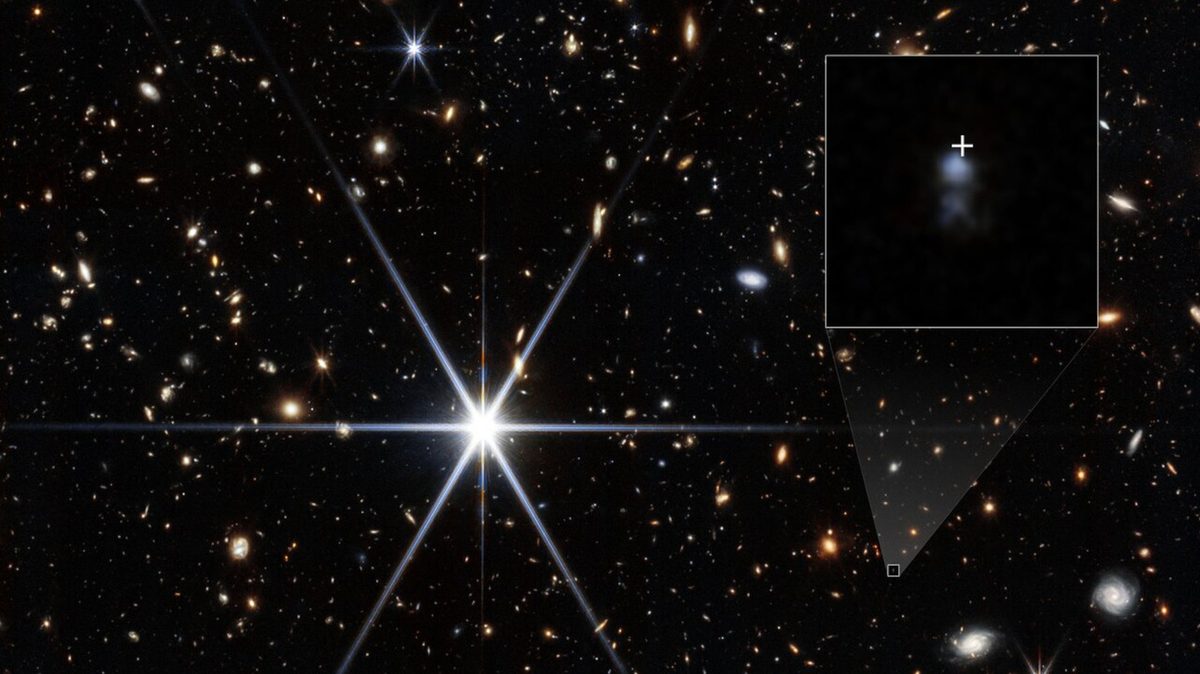
Astronomers have achieved a significant breakthrough in understanding the enigmatic phenomenon of Fast Radio Bursts (FRBs) by leveraging the unparalleled capabilities of the James Webb Space Telescope (JWST). For the first time, the origin of the most distant FRB ever detected has been precisely identified, offering crucial insights into the cosmic events that produce these powerful, fleeting signals. The FRB in question, initially detected in 2024 by the MeerKAT ground telescope array, originated from a galaxy located an astonishing 3 billion light-years away, a period when the universe was still in its cosmic dawn.
Key Details
- FRB Identification: The most distant Fast Radio Burst (FRB) ever detected has had its cosmic origin pinpointed by the James Webb Space Telescope.
- Cosmic Distance: The FRB originated from a galaxy approximately 3 billion light-years from Earth, dating back to a period when star formation was at its peak in the early universe.
- Galaxy Characteristics: The host galaxy is remarkably small, about 1,000 times smaller than galaxies typically associated with previously detected FRBs.
- Origin Theory Support: The findings lend strong support to the theory that FRBs can be produced by supernovae, rather than neutron star mergers, as previously hypothesized.
- Lead Author: Manisha Caleb from the University of Sydney, Australia, led the study published in the journal Science.
Background
Fast Radio Bursts are intense, millisecond-long flashes of radio waves originating from deep space. Despite their brief duration, they release an immense amount of energy, equivalent to the Sun's output over three days. First discovered in 2007, the exact mechanisms behind FRBs remain one of astrophysics' most compelling mysteries. While numerous FRBs have been detected since their discovery, pinpointing their precise cosmic origins has been a significant challenge, often requiring the combined power of multiple observatories.
Impact Analysis
The JWST's near-infrared instruments were instrumental in identifying the host galaxy of this record-breaking FRB. By analyzing the redshift of the galaxy's light—a measure of how much its light has been stretched by the expansion of the universe—scientists determined that the burst occurred just 3 billion years after the Big Bang. This places the event in a crucial epoch of cosmic history when the universe was undergoing rapid star formation. Crucially, the galaxy identified is significantly smaller than expected, challenging the prevailing notion that FRBs are exclusively produced in massive, star-forming galaxies. This discovery suggests that FRBs might be more common in a wider variety of galactic environments than previously thought.
“Our work suggests that it's very unlikely that this [fast radio burst] was produced by a merger,” stated Manisha Caleb, lead author of the study.
This statement directly challenges one of the leading theories for FRB generation: the merger of two neutron stars. Such mergers are thought to require billions of years to occur, implying that FRBs produced this way would originate from older, more evolved galaxies. The new findings, however, point towards an alternative explanation.
Broader Context
Astrophysicists have proposed several theories to explain the origin of FRBs. One prominent hypothesis suggests that FRBs are the result of the cataclysmic merger of two neutron stars, the incredibly dense remnants of massive supergiant stars. However, this process is believed to take billions of years, meaning such FRBs would likely originate from much older galaxies. Another leading theory posits that FRBs can arise from the explosive death of massive stars in a supernova, leaving behind a magnetar—a type of neutron star with an extraordinarily powerful magnetic field. The JWST's findings provide compelling evidence supporting this latter theory.
Future Outlook
The identification of this distant FRB's host galaxy marks a pivotal moment in FRB research. It opens up new avenues for investigation, encouraging astronomers to search for similar FRBs in smaller, earlier galaxies. Future observations with JWST and other advanced telescopes will be crucial in determining the frequency of FRBs in such environments and refining our understanding of the specific stellar processes that generate them. The possibility that FRBs are linked to supernovae, particularly in the early universe, could revolutionize our understanding of stellar evolution and the conditions present in the nascent cosmos.
Conclusion
The James Webb Space Telescope has provided an unprecedented glimpse into the origins of Fast Radio Bursts, identifying the host galaxy of the most distant FRB detected to date. This discovery, detailed in a study published in Science, not only pushes the boundaries of our cosmic horizon but also significantly refines our theoretical models. The finding that this powerful burst originated from a small galaxy in the early universe strongly supports the hypothesis that FRBs can be produced by supernovae, challenging the long-held neutron star merger theory. This breakthrough promises to unlock further secrets of these mysterious cosmic signals and the extreme astrophysical events that create them.
Source: engadget.com