Germany Reduced to Ten Men as Controversial Red Card Shifts Momentum in Women’s Euro 2025 Quarter-Final
Introduction
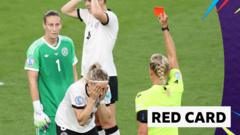
The quarter-final match of the Women’s Euro 2025 between Germany and France witnessed a dramatic turning point when German defender Kathrin Hendrich was shown a red card following a VAR review. The decision, stemming from a hair-pulling incident involving France’s Griedge Mbock, resulted in a penalty awarded to France. Midfielder Grace Geyoro converted the penalty, giving the French side a 1-0 lead and leaving Germany with ten players for the remainder of the match.
Key Details
- Kathrin Hendrich received a straight red card for pulling the hair of French defender Griedge Mbock after a VAR check.
- The incident led to a penalty awarded to France in a crucial knockout stage game.
- Grace Geyoro successfully converted the penalty, placing France ahead 1-0.
- The sending off significantly weakened Germany’s defensive structure, impacting the flow of the game.
- This match is part of the Women’s Euro 2025 quarter-final, highlighting the high stakes involved.
Background
The UEFA Women’s European Championship has grown in both competitiveness and popularity over recent years, showcasing some of the best talent in women’s football. Germany and France have historically been powerhouses in the tournament, with multiple titles and strong squads. Encounters between these two teams are often fiercely contested, both tactically and physically.
Kathrin Hendrich, a key player in Germany’s defense, is known for her aggressive style of play and leadership on the field. The incident that led to her dismissal reflects the intense pressure and high stakes of knockout football, where every action is scrutinized closely, especially with the help of Video Assistant Referee (VAR) technology.
Analysis
The decision to send off Hendrich was met with mixed reactions. Some viewed it as a clear enforcement of fair play, emphasizing that physical fouls such as hair pulling have no place in modern football. Others saw it as harsh, particularly given the timing and significance of the match. The use of VAR has brought more precision but also increased controversy, as subjective fouls are now subject to video replay and referee interpretation.
From a tactical perspective, Germany’s loss of a key defender forced head coach to rethink formations and defensive strategies. Playing with ten players against a team as strong as France is a significant disadvantage, often leading to increased pressure on remaining defenders and midfielders. France capitalized immediately by scoring from the penalty, boosting their morale and placing Germany on the back foot.
Grace Geyoro’s composure in taking the penalty highlighted the importance of mental resilience in high-pressure moments. Her goal not only provided a lead but also shifted momentum firmly in France’s favor. Historically, teams that receive an early advantage, especially from a penalty in knockout matches, often control the game dynamics thereafter.
Conclusion
The sending off of Kathrin Hendrich in the Women’s Euro 2025 quarter-final was a pivotal moment that influenced the trajectory of the match between Germany and France. While disciplinary actions are essential to maintain fairness, their timing and context can dramatically alter the outcomes in high-stakes tournaments. This incident underscores the growing role of VAR in shaping modern football and the fine margins that separate victory from defeat at the elite level.
As the tournament progresses, both teams will reflect on this game—Germany on the costly consequences of a momentary lapse, and France on the importance of capitalizing on opportunities. The match serves as a reminder of the intense physical and psychological battles that define international women’s football today.