Fiat Panda Slimmed to 19.7 Inches: A Radical DIY Transformation Weighing 600 lbs
Introduction
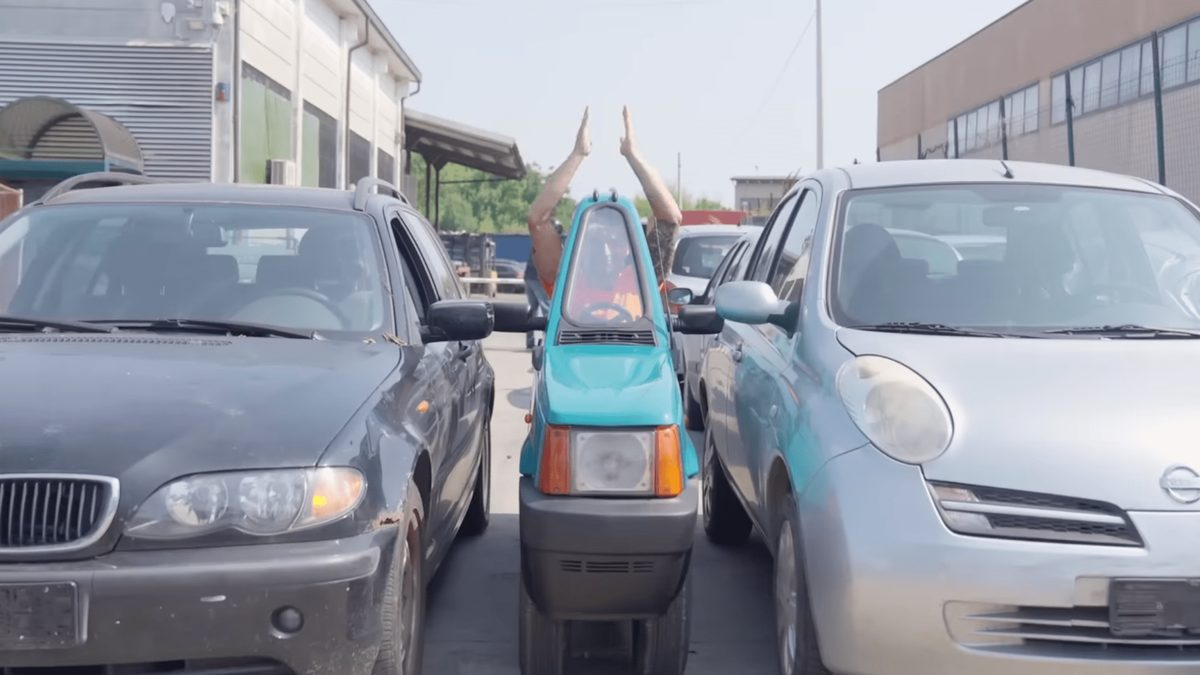
The Fiat Panda, a compact urban car known for its efficiency and maneuverability, has long been a favorite for city drivers, especially in Europe. Measuring 57.5 inches in width and weighing approximately 1,576 lbs, it represents a balance between usability and compactness. However, Italian DIY enthusiast Andrea Marazzi recently pushed these boundaries with an extraordinary modification that reduced the car’s width to an astonishing 19.7 inches—less than two feet. This project, documented extensively on TikTok, challenges common perceptions of vehicle size and usability.
Key Details
- The donor vehicle was a Fiat Panda, originally 57.5 inches wide.
- Marazzi removed approximately 37.8 inches of width, including a headlight and most of the windshield.
- The original inline 4-cylinder engine was replaced with a small electric motor powered by two 12-volt batteries.
- The final vehicle weighs about 600 lbs, less than half of the original.
- The Panda still retains original tires and both front and back seats, albeit significantly narrowed.
- The project was shared in a series of TikTok videos gaining attention for its ingenuity and extreme compactness.
Background
The Fiat Panda debuted in 1980 and quickly became prominent for its practicality and compact urban footprint. Named after Empanda, the Roman goddess of travelers, the Panda has sold roughly 7.8 million units as of 2020. The vehicle enjoys a cult following and even boasts an annual festival, Panda in Pandino, held in an Italian castle celebrating this iconic city car.
While the Fiat Panda was designed to navigate narrow European streets efficiently, Marazzi’s project significantly surpasses standard design parameters, exploring just how minimal a drivable car can become. The original Panda’s width of nearly five feet already represents a narrow footprint compared to typical vehicles, but Marazzi’s build is less than half that width.
Impact Analysis
The extreme narrowing of the Fiat Panda raises important questions about vehicle design, safety, and usability. By squeezing the width down to 19.7 inches, the car approaches the dimensions of some motorcycles or bicycles, creating a unique but claustrophobic driving experience. Although it remains drivable, the slimmed-down Panda is no longer practical for most drivers or everyday use.
The replacement of the gasoline engine with an electric motor and batteries also highlights a growing trend in vehicle customization, emphasizing sustainability and compact powertrains. However, the electric setup is modest, likely limiting speed and range, thus confining the car primarily to short-distance, novelty use rather than practical transportation.
Moreover, safety considerations are paramount: the drastic width reduction compromises structural integrity and crash protection, which are critical in modern automotive engineering. Marazzi’s Panda, while a fascinating engineering feat, serves more as an artistic and technical experiment than a viable alternative to conventional city cars.
Broader Context
Compact cars like the Fiat Panda cater to urban environments where space is at a premium and fuel efficiency is vital. The global automotive industry has seen increasing interest in electric vehicles and microcars, vehicles designed to maximize efficiency while minimizing environmental impact. Marazzi’s project can be seen as an extreme exploration within this context, pushing the limits of miniaturization and electric propulsion.
The project also reflects a vibrant maker culture where enthusiasts use social media platforms such as TikTok to document and share their inventive projects, inspiring communities and spreading ideas about DIY vehicle modifications. This cultural shift democratizes automotive experimentation, allowing individuals to challenge traditional manufacturing norms.
Future Outlook
While Marazzi’s ultra-narrow Fiat Panda remains a novelty, it demonstrates potential pathways for future vehicle innovation, particularly in urban mobility and electric vehicle design. As cities continue to grapple with congestion and environmental concerns, ultra-compact, electric-powered personal transport could gain traction, albeit with significant adaptations for safety and comfort.
Manufacturers might draw inspiration from such projects to develop new classes of micro electric vehicles optimized for dense urban settings. However, balancing extreme compactness with regulatory requirements and consumer expectations will remain a critical challenge.
Conclusion
Andrea Marazzi’s transformation of a Fiat Panda into the world’s narrowest car at 19.7 inches wide is a remarkable display of creativity and technical skill. Weighing just 600 lbs and powered by an electric motor, the vehicle challenges traditional ideas about car size and functionality. While it is unlikely to replace conventional vehicles, this project offers valuable insights into the possibilities and limitations of extreme vehicle downsizing and electrification.
"This is proof that it can efficiently corner," Marazzi states in his TikTok videos, underlining that despite its radical dimensions, the car remains drivable and controllable.
Ultimately, Marazzi’s Panda stands as a testament to the inventive spirit and the endless pursuit of customization within automotive culture.