Dine Brands' Dual-Brand Restaurants Nearly Triple Sales, Plans 900 New Locations
Introduction
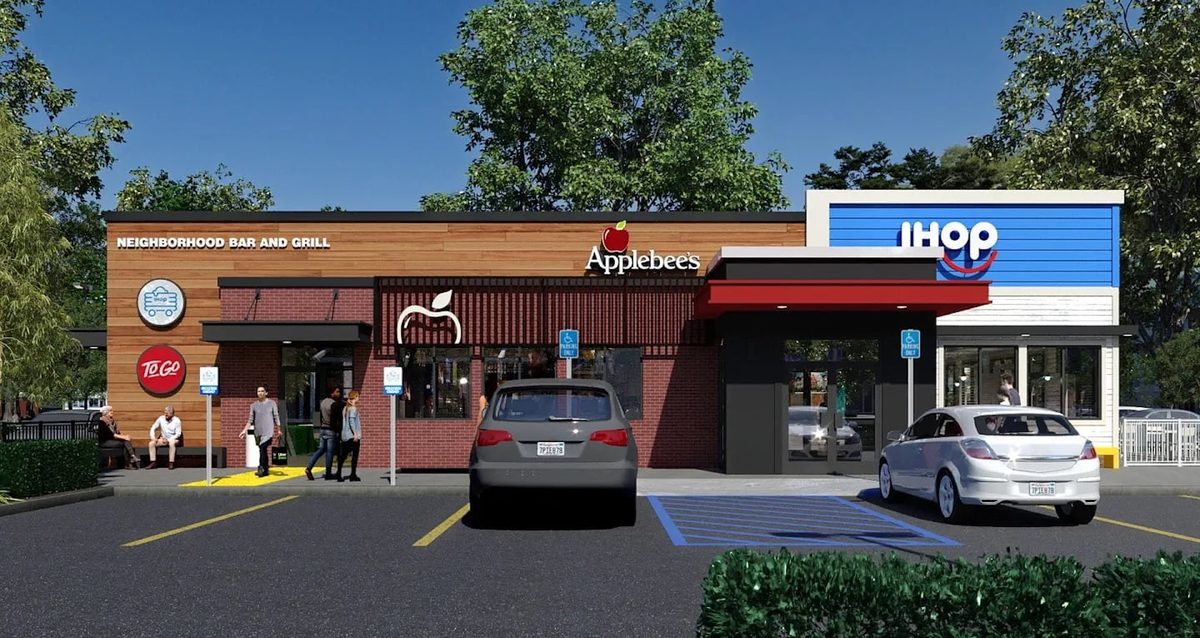
In a bold move signaling a significant shift in casual dining strategy, Dine Brands, the parent company of iconic American eateries IHOP and Applebee’s, is aggressively expanding its dual-brand restaurant concept. The first of these combined locations, situated in Seguin, Texas, has demonstrated remarkable success, nearly tripling the sales of a traditional standalone IHOP. This impressive performance has spurred Dine Brands to aim for 80 such dual-brand establishments by the end of the current year, with an ambitious long-term vision of establishing 900 locations over the next decade.
Key Details
- Concept: A single physical location housing both an IHOP and an Applebee’s, sharing a common entrance but featuring distinct seating areas.
- Design: Each brand maintains its own designated seating zone, color-coded for easy identification (red for Applebee’s, blue for IHOP). A streamlined, daypart-organized menu aims to simplify the ordering process.
- Performance: The initial dual-brand unit in Seguin, Texas, saw sales nearly triple compared to a standalone IHOP.
- Expansion Goals: Dine Brands plans to reach 80 dual-brand locations by the end of this year, up from the current 45. CEO John Peyton projects a potential for 900 such units within the next 10 years.
- Investment: Converting a single-brand restaurant into a dual-brand unit costs approximately $1 million, with the potential to roughly double revenue.
Background
The restaurant industry is no stranger to co-branding initiatives, with several major players experimenting with pairing complementary concepts. Examples include Buffalo Wild Wings co-located with Jimmy John’s, and Dunkin’ with Baskin-Robbins. Dine Brands’ foray into this trend with IHOP and Applebee’s is a strategic response to evolving consumer preferences and the challenging economic landscape. While Applebee’s has faced headwinds, including a 1.8% decline in same-store sales this quarter attributed to inflation and cautious consumer spending, IHOP has shown resilience, outperforming industry benchmarks for three consecutive quarters with a 1.5% increase in same-store sales and a notable 22% surge in its catering business.
Impact Analysis
The financial implications of this dual-brand strategy are significant. Dine Brands reported a 4.4% increase in overall revenue, reaching $240.9 million in the second quarter. However, profits saw a slight dip of 3.6%, a consequence of substantial investments in renovations and the ongoing rollout of the IHOP-Applebee’s concept. The company is clearly prioritizing long-term growth and market share expansion over short-term profit maximization. The potential to nearly double revenue at an investment of around $1 million per conversion presents a compelling financial case, especially in a market where driving traffic and increasing average check sizes are paramount.
Broader Context
This strategic pivot occurs at a critical juncture for the casual dining sector. Persistent inflation, rising operational costs, and shifting consumer spending habits have put immense pressure on established brands. By combining two well-known entities under one roof, Dine Brands aims to create a more robust and versatile offering. This approach can potentially attract a wider customer base, catering to different dining occasions and preferences within a single visit. The shared entrance and distinct zones allow for operational efficiencies while maintaining brand identity. This model could serve as a blueprint for other restaurant groups seeking to innovate and adapt to the new realities of the post-pandemic dining landscape.
Future Outlook
The ambitious target of 900 dual-brand locations suggests a strong conviction within Dine Brands’ leadership about the viability and profitability of this model. If successful, this strategy could redefine the physical footprint and operational model for both IHOP and Applebee’s, potentially leading to increased brand visibility and market penetration. The company will need to carefully manage the integration process, ensuring consistent quality and customer experience across all locations. Furthermore, monitoring consumer response and adapting to market dynamics will be crucial for sustained success. The potential for 900 units implies a significant transformation of Dine Brands’ portfolio, moving towards a more integrated and efficient operational structure.
Conclusion
The success of the Seguin, Texas, dual-brand IHOP-Applebee’s location is a powerful testament to the potential of co-branding in the casual dining industry. Dine Brands’ aggressive expansion plans, aiming for 900 new units, underscore their confidence in this innovative model. Despite the current economic challenges impacting the broader restaurant sector, this strategy offers a promising path toward increased revenue and market resilience. The company’s willingness to invest heavily in this concept, even at the expense of short-term profits, signals a long-term vision focused on sustainable growth and adaptation in a rapidly evolving market.
Source: entrepreneur.com