‘A Statement’ Film: Talky Seriocomedy Highlights 1980 Climate Talks Futility
Introduction
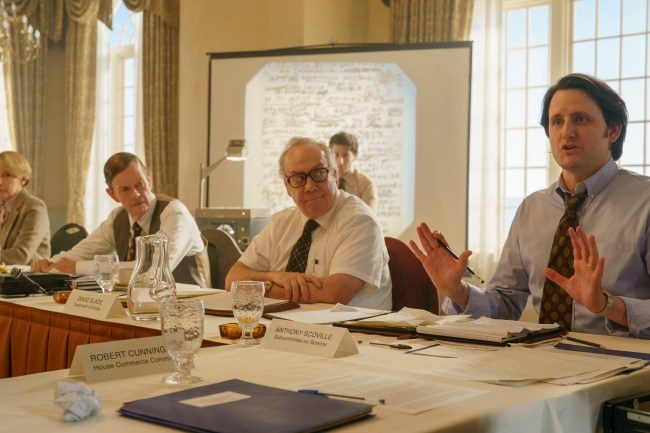
In the annals of climate change discourse, few moments are as emblematic of early inaction as the 1980 congressional commission tasked with addressing carbon dioxide emissions. Tom McCarthy’s latest film, ‘A Statement,’ delves into this pivotal, yet ultimately fruitless, gathering. Set in a plush St. Petersburg, Florida hotel conference room, the film meticulously reconstructs the 36-hour debate among leading scientists, policymakers, and industry figures. Rather than offering a polemic, McCarthy crafts a talky, seriocomic treatise on the inherent limitations of language and collective action when confronted with an existential threat.
Key Details
- Film Title: ‘A Statement’
- Director: Tom McCarthy
- Source Material: Nathaniel Rich’s book ‘Losing Earth’
- Setting: October 1980, DonCesar beachfront resort, St. Petersburg, Florida
- Event: A 36-hour ad hoc commission meeting to discuss CO2 emissions and potential action.
- Cast: Paul Rudd (Thomas Jorling), Evan Peters (Rafe Pomerance), Amy Ryan (Annemarie Crocetti), Paul Giamatti (David Slade), John Turturro (David Rose), Tatiana Maslany (Edith Brown Weiss).
- Screenplay: Written by Tom McCarthy, Thomas Bidegain, and Noé Debré, incorporating verbatim transcripts.
- Cinematography: Stuart Dryburgh
- Score: Bryce Dessner
- Premiere: 2026 New York Film Festival
- Distributor: Sony Pictures Classics
Background
The film draws from Nathaniel Rich’s 2019 book, ‘Losing Earth: A View from 1979,’ which chronicles the period when humanity first understood the threat of climate change but failed to act decisively. ‘A Statement’ focuses on a specific episode: a two-day meeting in October 1980 where twenty experts convened to grapple with the escalating issue of CO2 emissions. This was a time when the scientific consensus was forming, yet political and industrial inertia, coupled with the nascent understanding of the problem’s scale, meant that meaningful action remained elusive. The film highlights the stark contrast between the urgency of the scientific warnings, echoing John Tyndall’s 1859 observations, and the bureaucratic, often banal, human processes attempting to address it.
Impact Analysis
‘A Statement’ offers a sobering, albeit darkly comedic, perspective on the challenges of collective decision-making, particularly concerning complex, long-term issues like climate change. The film’s central thesis is that even the brightest minds, armed with scientific data and good intentions, can be stymied by the failures of language, semantics, and institutional bureaucracy. The decision to use verbatim transcripts for much of the dialogue underscores this point, revealing conversations that are often more about procedural debates and nuanced definitions than about concrete solutions. The result is a film that, while sometimes slow-paced, effectively conveys a profound sense of frustration and impending doom. The characters, despite stellar performances, often feel like archetypes representing different facets of the debate – the scientist, the politician, the activist, the industry representative – rather than fully fleshed individuals. This stylistic choice, while potentially alienating for some viewers, serves McCarthy’s overarching theme of systemic paralysis.
Broader Context
The film is set against the backdrop of a politically charged era. The meeting takes place just days before the 1980 U.S. presidential election, which saw Ronald Reagan defeat incumbent Jimmy Carter. Reagan’s subsequent environmental policies, often characterized by deregulation, further complicated efforts to address climate change. ‘A Statement’ subtly reminds viewers of the long historical trajectory of climate inaction, a narrative that has continued through subsequent administrations, including the U.S. withdrawal from the Paris Agreement. The film’s conclusion, which reveals that the commission produced no statement at all, serves as a stark metaphor for the decades of missed opportunities and the ongoing struggle to translate scientific understanding into effective global policy. The portrayal of women, such as Tatiana Maslany’s Edith Brown Weiss and Amy Ryan’s Annemarie Crocetti, attempts to highlight the specific challenges they faced in asserting their expertise within a male-dominated field, though the film is criticized for not fully developing these characters beyond their thematic roles.
Future Outlook
‘A Statement’ provides a historical lens on a problem that remains acutely relevant. Its depiction of a seemingly intelligent group failing to reach consensus serves as a cautionary tale for contemporary climate negotiations. The film suggests that the fundamental issues of communication, political will, and overcoming vested interests that plagued the 1980 meeting continue to hinder progress today. While the film offers little in the way of hope, its value lies in its unflinching portrayal of the complexities and historical roots of climate inaction. It prompts reflection on whether humanity’s capacity for collective action has fundamentally changed since 1980, or if the same linguistic and political barriers persist. The film’s muted, almost Beckettian, conclusion leaves the audience contemplating the enduring difficulty of confronting existential threats.
Conclusion
Tom McCarthy’s ‘A Statement’ is a unique cinematic experiment, using the dry, procedural nature of a historical transcript to explore the profound failure to act on climate change in 1980. While its talky, stagelike nature might not appeal to all, the film succeeds in its ambitious goal: to dissect the ways in which language, bureaucracy, and human nature conspire to obstruct even the most critical endeavors. It’s a muted, sobering, and ultimately poignant reflection on a moment when the world stood at a precipice and collectively, if unintentionally, stepped back. The film’s enduring message is one of profound futility, a stark reminder of the long and arduous road humanity has traveled, and continues to travel, in its fight against a self-inflicted crisis.
Source: indiewire.com