Silicon Valley Leaders Adopt Trump's 'Super Intelligence' Terminology Amid Shifting Political Landscape
Introduction
In a surprising turn of events, several influential figures in Silicon Valley have begun adopting the terminology championed by former President Donald Trump, specifically his preferred term “Super Intelligence” over the widely accepted “Artificial Intelligence” (AI). This shift, observed among titans like Elon Musk, Marc Benioff, Jensen Huang, and Satya Nadella, suggests a strategic recalibration within the tech industry as it navigates its relationship with political power, particularly in anticipation of potential future administrations.
Key Details
- Elon Musk, CEO of SpaceX and Tesla, has pledged to rename SpaceXAI to SpaceXSI, explicitly embracing the “Super Intelligence” moniker.
- Marc Benioff, CEO of Salesforce, announced a rebranding of AIForce to SIForce shortly after Trump declared “Artificial Intelligence” as the term for “THE ENEMY.”
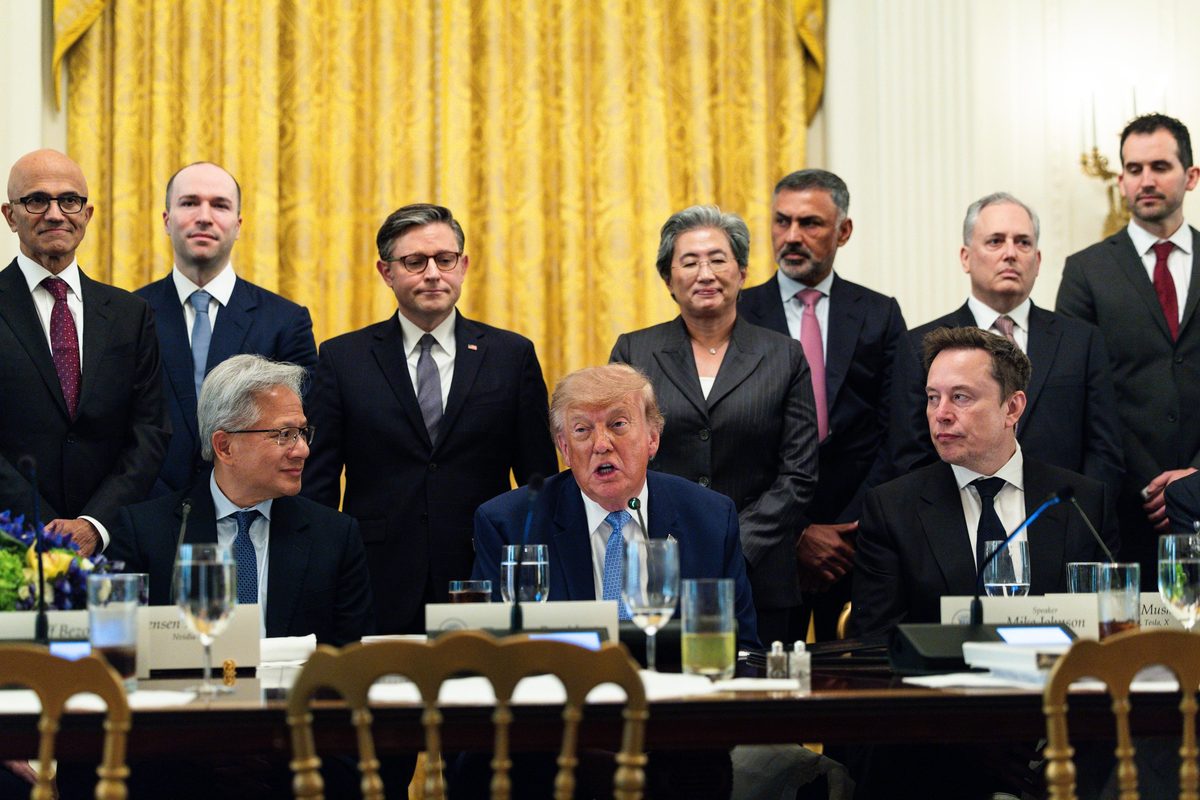
- Jensen Huang, CEO of Nvidia, attended the White House summit where the “Super Intelligence” directive was announced and has publicly downplayed AI’s perceived dangers, aligning with the administration’s stance. Nvidia has committed $1 billion to scientific advancement, including “super intelligence research.”
- Satya Nadella, CEO of Microsoft, recently referred to AI technologies as “super intelligence” multiple times in a public statement, marking the latest prominent executive to adopt the term.
- The shift follows a White House summit where Trump mandated government agencies to use “Super Intelligence” instead of “Artificial Intelligence.”
Background
The term “Super Intelligence” was popularized by Trump, who declared that using “Artificial Intelligence” would be considered an act of opposition to his administration. This directive came during a White House summit focused on AI safety and development. The move by these tech leaders represents a notable departure from their previous, often contentious, relationship with the Trump administration during his first term. In contrast, during his second term, there appears to be a concerted effort by some in Silicon Valley to foster a more amicable relationship, potentially to safeguard their interests and influence.
Impact Analysis
The adoption of “Super Intelligence” by key industry players could have a ripple effect, influencing public perception, research funding, and the broader discourse surrounding advanced AI. By aligning with Trump’s terminology, these executives may be seeking to curry favor, avoid political friction, or perhaps genuinely believe in the merits of the new term. However, this rebranding also risks diluting the established understanding of AI and could be perceived as a purely political maneuver. The emphasis on “super intelligence” might also subtly shift the focus towards more advanced, potentially speculative, AI capabilities, rather than the current state of AI technologies.
Broader Context
This development occurs against a backdrop of intense global scrutiny and debate surrounding AI regulation, ethics, and its societal impact. Governments worldwide are grappling with how to manage the rapid advancement of AI, balancing innovation with safety concerns. Silicon Valley’s willingness to adopt Trump’s terminology, even if superficial, highlights the complex interplay between technological innovation and political maneuvering. It underscores how major tech companies often adapt their strategies and public messaging to align with prevailing political winds, especially when significant business interests are at stake.
Future Outlook
The long-term impact of this terminology shift remains to be seen. If Trump were to regain political office, this early adoption could prove strategically advantageous for these companies. Conversely, if the broader public and scientific community largely ignore the rebranding, these efforts might be seen as a miscalculation. The debate over AI terminology is likely to continue, intertwined with discussions about AI safety, governance, and the future trajectory of artificial intelligence development. The industry’s response will be a key indicator of its ability to navigate an increasingly politicized technological landscape.
Conclusion
The embrace of “Super Intelligence” by prominent Silicon Valley leaders signifies a strategic adaptation to the political climate. While the motivations may be multifaceted—ranging from political expediency to genuine agreement—this shift underscores the delicate balance tech giants must strike between innovation, public perception, and political influence. As AI continues its rapid evolution, the language used to describe it will undoubtedly remain a focal point of discussion, reflecting both technological advancements and the ever-present influence of the political arena.
Source: theverge.com