LIGO Detects Most Massive Black Hole Merger Ever: A Gravitational Wave Breakthrough
LIGO Detects Most Massive Black Hole Merger Ever: A Gravitational Wave Breakthrough
Introduction
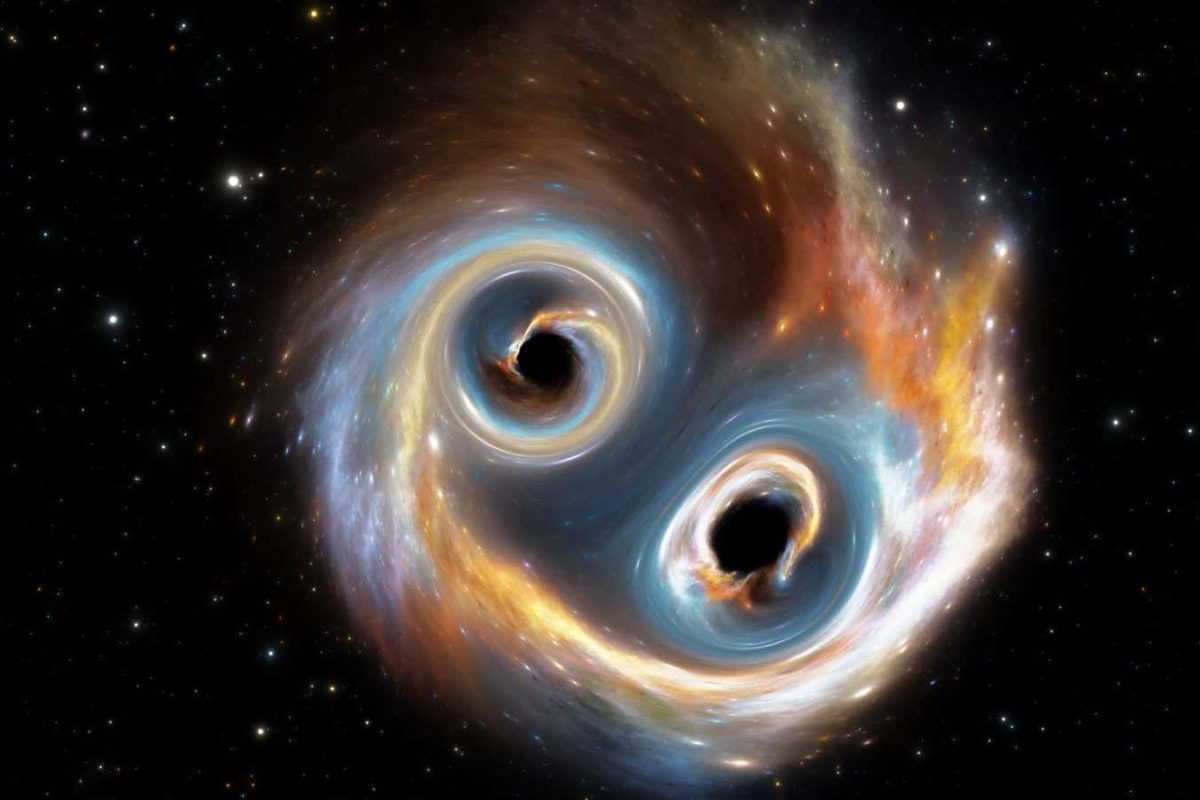
In a landmark achievement for astrophysics, the Laser Interferometer Gravitational-Wave Observatory (LIGO) has detected the most massive black hole collision ever observed. The gravitational wave signal, labeled GW190521, emerged from the cataclysmic merger of two black holes, resulting in a final black hole with a mass of approximately 142 times that of the Sun. This extraordinary event not only marks a new milestone in gravitational wave astronomy but also raises profound questions about how such massive black holes form and evolve.
Key Details
The detection, first announced in 2020 and further analyzed in subsequent studies, revealed several unprecedented characteristics:
- Massive progenitors: The two merging black holes had masses of about 85 and 66 solar masses, making them unusually large for stellar-origin black holes.
- Final product: The resulting black hole has a mass of 142 solar masses, placing it firmly in the rare 'intermediate-mass' black hole category.
- Signal anomaly: Unlike typical chirp-like signals from black hole mergers, GW190521 appeared as a short, burst-like pulse, lasting less than a tenth of a second.
- Energy release: The collision converted roughly 8 solar masses into pure energy in the form of gravitational waves, making it one of the most energetic events ever recorded.
- Distance: The event occurred about 7 billion light-years away, meaning it took place when the universe was roughly half its current age.
Background
Since the first direct detection of gravitational waves in 2015, LIGO — along with its European counterpart Virgo — has opened a new window into the universe. These ripples in spacetime, predicted by Einstein’s general theory of relativity, are generated by violent cosmic events, particularly the merging of compact objects like black holes and neutron stars. Most detected mergers involve black holes under 50 solar masses, formed from the collapse of massive stars. However, the progenitor black holes in GW190521 fall into a theoretically forbidden range known as the 'pair-instability mass gap.'
This gap, predicted by stellar evolution models, suggests that stars with certain masses (between about 65 and 120 solar masses) should be completely blown apart in supernovae, leaving no black hole remnants. The existence of an 85-solar-mass black hole challenges this model and hints at alternative formation pathways — such as hierarchical mergers in dense stellar clusters or primordial origins from the early universe.
Analysis
The discovery of GW190521 has sparked intense debate among astrophysicists. The intermediate-mass black hole (IMBH) resulting from the merger is particularly significant, as such objects have long been considered 'missing links' between stellar-mass and supermassive black holes found at galaxy centers. Confirming their existence helps bridge a crucial gap in our understanding of black hole evolution.
One compelling hypothesis is that the two progenitor black holes themselves were the products of earlier mergers. This hierarchical growth model suggests that in environments like globular clusters or galactic nuclei, black holes can repeatedly collide and grow over time. Alternatively, the 85-solar-mass black hole might have formed directly from the collapse of a supermassive star in the early universe, bypassing the pair-instability limit.
The burst-like nature of the signal also suggests the black holes may have merged on a highly eccentric orbit, possibly due to dynamical interactions in a crowded stellar environment. This contrasts with the more commonly observed inspiraling binaries formed from isolated binary star systems.
Conclusion
GW190521 is not just a record-breaking event — it is a transformative discovery that challenges long-standing assumptions in astrophysics. It underscores the power of gravitational wave astronomy to probe extreme physics and uncharted regions of the cosmos. As LIGO and future observatories like the Einstein Telescope and LISA come online, scientists anticipate uncovering more such anomalies, ultimately leading to a deeper understanding of black hole populations, galaxy evolution, and the fundamental nature of gravity itself.