CHIME Telescope Achieves Independent Dark Energy Measurement Using Ancient Hydrogen
Introduction
Scientists have unveiled a significant advancement in the quest to understand the universe's accelerating expansion. Canada's pioneering CHIME telescope has, for the first time, successfully used its own data to measure dark energy, a mysterious force driving this cosmic acceleration. This achievement, detailed in a recent publication in The Astrophysical Journal, bypasses the need for costly and time-consuming confirmation from other observatories, potentially ushering in a new era of cosmology research.
Key Details
- Independent Measurement: The CHIME telescope has demonstrated its capability to independently measure dark energy using observations of ancient hydrogen gas.
- Cosmic Tracer: The faint radio emissions from hydrogen, the most abundant element in the universe, act as a tracer, revealing the distribution of matter across vast cosmic distances.
- Early Universe Data: CHIME can detect radio signals dating back to approximately 3 billion years after the Big Bang, offering a glimpse into the universe's formative stages.
- Publication: The findings are published in The Astrophysical Journal, with a companion paper offering further details on hydrogen distribution.
- Neutrally Atomic Hydrogen: The study suggests that about 2% of hydrogen is neutrally atomic, a finding consistent with previous measurements from other telescopes.
Background
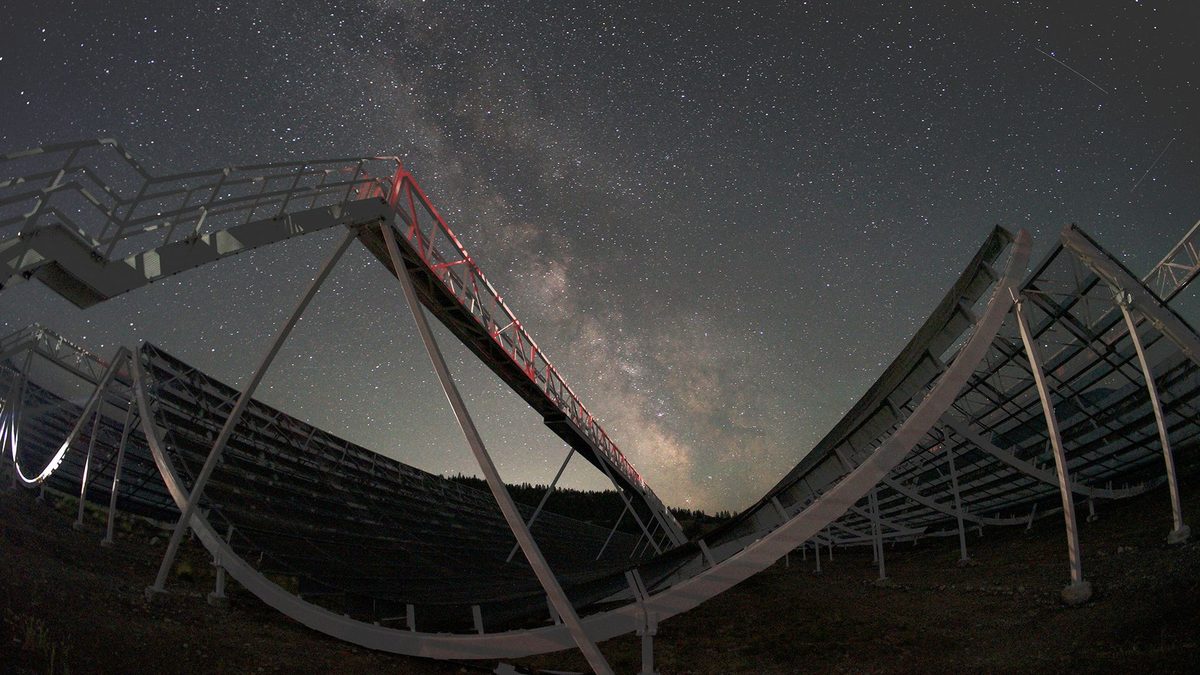
The Canadian Hydrogen Intensity Mapping Experiment (CHIME) is a sophisticated radio telescope array situated near Penticton, British Columbia. Its primary mission is to map the entire northern sky daily, charting the distribution of hydrogen gas throughout the cosmos. For years, CHIME's groundbreaking observations required validation from other telescopes, a process that, while scientifically rigorous, presented logistical and financial challenges. The recent study marks a pivotal moment, proving CHIME's self-sufficiency in its measurements. This independence is crucial for establishing a reliable, standalone data point for cosmological studies.
Impact Analysis
The ability of CHIME to independently measure dark energy is a game-changer for the field of cosmology. Dark energy remains one of the biggest puzzles in modern physics, responsible for the observed phenomenon that the universe's expansion is not only ongoing but also accelerating. Traditional methods for studying dark energy often involve complex observational campaigns requiring coordination across multiple facilities. CHIME's breakthrough offers a more streamlined and cost-effective approach. By utilizing the ubiquitous hydrogen gas as a probe, scientists can potentially gather more data, more efficiently, and from more epochs of cosmic history than ever before. The study's authors, including Arnab Chakraborty from the University of Toronto and Shabbir Shaikh from Arizona State University, have spent nearly a decade refining their methods to ensure the accuracy of these faint signals. “We worked very hard to convince ourselves that this wasn't a false alarm,” stated Chakraborty, emphasizing the rigorous testing involved. “After all the tests, the signal remained. That gave us confidence we were seeing real hydrogen from the distant universe.”
Broader Context
This development occurs against a backdrop of intense scientific interest in the universe's expansion rate, often referred to as the Hubble constant. Discrepancies in measurements of this constant have led to a “Hubble tension,” a significant disagreement between early universe measurements and those from the local universe. New observational tools and techniques, like the one pioneered by CHIME, are vital for resolving such cosmic conundrums. Hydrogen, being the most fundamental building block of stars and galaxies, provides an unparalleled window into the universe's structure and evolution. Its faint radio emission, specifically the 21-centimeter line, allows astronomers to map the distribution of neutral hydrogen gas across cosmic time. CHIME's ability to detect this signal from the early universe, as far back as 3 billion years post-Big Bang, offers a unique perspective on how matter clumped together and how the universe expanded during that critical period.
Future Outlook
The success of this initial independent measurement is just the beginning for CHIME. The research team plans to delve into the seven years of accumulated observational data from the telescope. This extensive dataset promises to yield a much richer and more detailed map of hydrogen distribution across cosmic history. By analyzing this wealth of information, scientists hope to refine our understanding of dark energy's behavior over time and potentially uncover new physics that governs the universe's ultimate fate. The prospect of using CHIME's data to independently probe the Hubble constant and other cosmological parameters is particularly exciting, offering a crucial cross-check to existing measurements and potentially helping to resolve the ongoing Hubble tension.
Conclusion
The CHIME telescope's achievement of an independent dark energy measurement represents a significant leap forward in observational cosmology. By leveraging the faint radio signals of ancient hydrogen gas, scientists now possess a powerful, cost-effective new tool to probe the universe's accelerating expansion. This breakthrough, born from years of dedicated work and rigorous validation, not only validates CHIME's capabilities but also opens up exciting avenues for future research. As scientists analyze the vast archives of CHIME data, the mysteries of dark energy and the universe's expansion may soon begin to unravel, thanks to this Canadian marvel.
Source: livescience.com