Breakthrough in Ultra-High-Energy Cosmic Ray Research Sheds Light on Particle Composition
Introduction
Ultra-high-energy cosmic rays (UHECRs) have fascinated scientists for decades due to their enigmatic origins and extreme energies. These cosmic rays, which are particles traveling through space at energies exceeding 1018 electronvolts, collide with Earth's atmosphere, creating showers of secondary particles. Understanding the composition of these cosmic rays is vital for uncovering the astrophysical processes that generate such immense energies. Recent developments using data from the IceCube neutrino detector have provided new answers to a perplexing question: what particles make up these ultra-high-energy cosmic rays?
Key Details
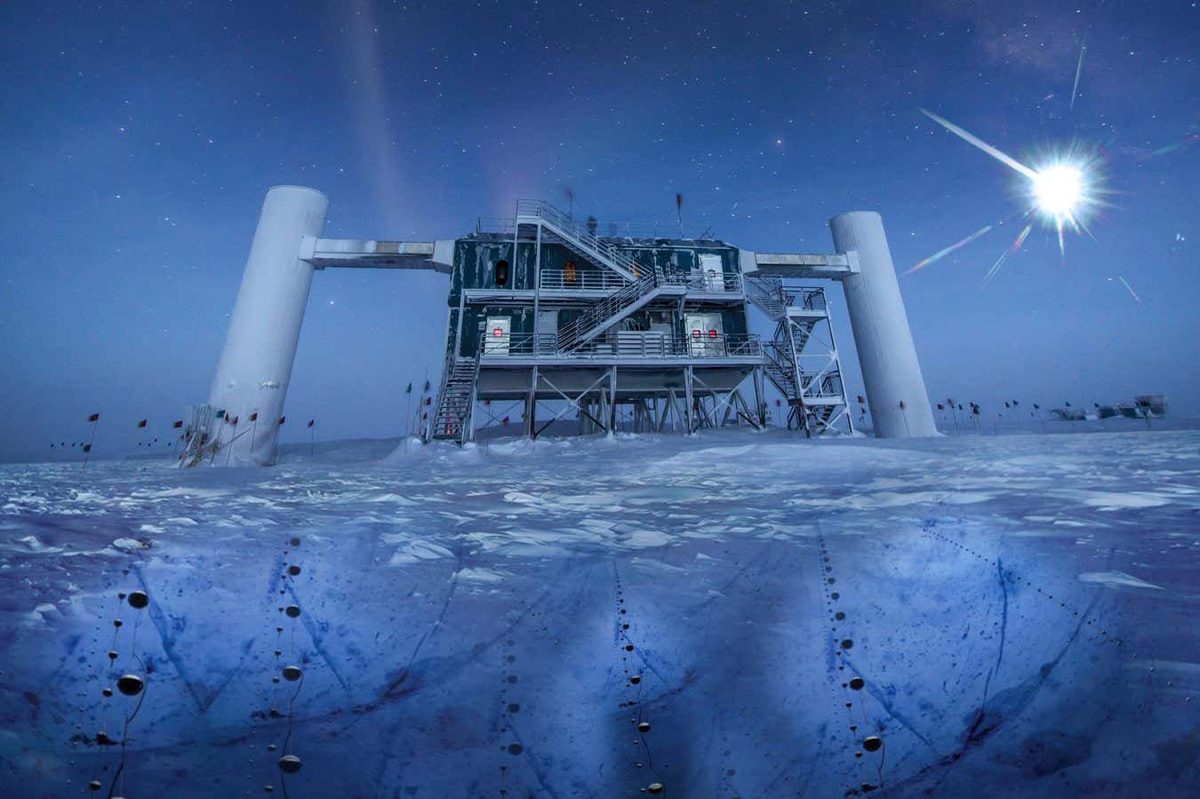
- The IceCube neutrino detector, located at the South Pole, has been instrumental in detecting neutrinos produced by cosmic ray interactions.
- By analyzing neutrino signals, researchers have distinguished between different particle types involved in UHECRs, particularly differentiating between protons and heavier nuclei.
- This breakthrough helps resolve debates that have persisted for many years regarding whether UHECRs are predominantly protons or a mixture of heavier elements like iron.
- Despite these advances, many aspects of UHECR origins and propagation remain uncertain due to their rarity and complexity.
Background
Cosmic rays were discovered over a century ago, yet their most energetic varieties remain one of the biggest mysteries in astrophysics. Traditional observatories detect extensive air showers created when these particles strike the atmosphere, but such methods provide limited information about the primary particle's identity. The IceCube detector, primarily designed to observe neutrinos, offers a unique vantage point. Neutrinos, elusive particles capable of passing through matter almost undisturbed, are byproducts of cosmic ray interactions with cosmic microwave background radiation and interstellar matter.
For years, scientists have debated whether UHECRs are mostly light particles like protons or heavier atomic nuclei. This distinction is critical because it informs theories about their sources — whether they originate from distant active galactic nuclei, gamma-ray bursts, or other astrophysical phenomena. The difficulty lies in the fact that heavier nuclei and protons produce different secondary particle signatures, but these are challenging to capture and interpret with existing technology.
Analysis
The latest IceCube analyses employed neutrino detection to infer the composition of UHECRs indirectly. Neutrinos produced in cosmic ray interactions carry unique signatures dependent on the initial particle type. By correlating neutrino events with cosmic ray measurements, scientists have gained evidence favoring a mixed composition model rather than a pure proton scenario. This finding narrows the range of plausible astrophysical sources and helps refine models of cosmic ray acceleration mechanisms.
Furthermore, the ability to identify particle types enhances our understanding of cosmic ray propagation through intergalactic space, including interactions with magnetic fields and background radiation. This knowledge is crucial for interpreting observed cosmic ray spectra and for the future design of detectors aiming to explore the high-energy universe.
Nevertheless, challenges remain. The rarity of UHECRs means data collection is slow and statistical uncertainties persist. Additionally, the complex interactions governing cosmic ray production and travel through space require sophisticated modeling. Continued collaboration between neutrino observatories, cosmic ray detectors, and theoretical astrophysicists is essential to build a comprehensive picture.
Conclusion
The insights gained from the IceCube neutrino detector represent a major step forward in solving the puzzle of ultra-high-energy cosmic ray composition. Although the debate is not fully closed, the evidence supports a nuanced view of cosmic rays as a complex mixture of particle types. This progress underscores the importance of multi-messenger astronomy, combining neutrino and cosmic ray data to unlock the secrets of the most energetic phenomena in the universe. Ongoing research promises to deepen our understanding of the cosmos and the extreme processes shaping it.